
Whole-body MRI can find unsuspected cancers and other serious abnormalities without radiation, but in people with no symptoms it detects cancer in only about 1.5 percent of scans and turns up many harmless findings along the way. The American College of Radiology does not recommend routine total-body MRI for people without symptoms or risk factors, because no study has shown it helps people live longer. It has a clearer role for people with inherited cancer syndromes such as Li-Fraumeni. For everyone else, the real question is how much to look, and what you will do with what you find.
What’s in this post?
- What a Whole-Body MRI Actually Sees
- The Case for Looking Before Symptoms Appear
- What Happens When We Scan People Who Feel Healthy?
- When Finding More Is Not Always Better
- Why Your Personal Risk Matters
- Whole-Body MRI Is One Tool, Not the Entire Toolkit
- How We Approach Whole-Body MRI at Ikigai
- Knowing When to Look
Imagine discovering a kidney cancer before it causes symptoms, while it is still small enough to treat effectively. Or identifying a potentially dangerous vascular abnormality that might otherwise have remained hidden for years. These are among the possibilities offered by whole-body magnetic resonance imaging (MRI), also known as a full-body MRI, a technology that allows us to examine much of the human body without radiation or an invasive procedure. The appeal is obvious: if we can look for serious disease before it announces itself, shouldn't we consider doing so?
That question becomes particularly compelling when we consider the limitations of conventional cancer screening. Despite decades of progress, roughly 70 percent of cancer deaths occur from cancers for which we do not have established routine screening programs. Kidney, pancreatic, ovarian, and many other cancers may develop silently, with symptoms appearing only after the disease has advanced. By then, treatment may be more difficult, and the opportunity for cure diminished. As we explored in our earlier Insights on the gaps in cancer screening, this remains one of preventive medicine's most consequential blind spots.
New technologies, including blood-based multicancer early detection tests and advanced imaging, offer possible ways to close that gap. But they also raise a difficult question: how much should we look for disease in people who feel perfectly healthy? Unlike a blood test designed to identify a possible cancer signal, whole-body MRI provides an anatomical view of the body. It can reveal suspicious tumors, vascular abnormalities, and other findings with implications for long-term health. Its potential extends beyond cancer detection, making its value, and its limitations, more complicated to assess.
What a Whole-Body MRI Actually Sees
Magnetic resonance imaging uses powerful magnetic fields and radiofrequency signals to create detailed images of internal structures. Unlike CT scans or conventional X-rays, MRI does not expose patients to ionizing radiation, an appealing distinction when imaging is being considered for preventive purposes rather than to investigate a known medical problem.
A whole-body examination typically surveys major portions of the body, including the brain, neck, chest, abdomen, and pelvis. Depending on the protocol, it may also evaluate the spine, major joints, and other structures. Radiologists look for suspicious masses, changes in organs, and unusual vascular structures. Some examinations incorporate specialized imaging sequences that provide additional information about tissue characteristics.
But a whole-body MRI is not equivalent to receiving a dedicated MRI of every organ. A comprehensive examination must balance anatomical coverage, resolution, and scanning time. Many screening protocols do not use intravenous contrast, limiting the characterization of certain abnormalities. Small lung lesions, early gastrointestinal cancers, and some breast cancers may be difficult to detect reliably with a general whole-body protocol.
A normal whole-body MRI is therefore reassuring in some respects, but it does not establish that someone is cancer-free. Nor does it replace mammography, colonoscopy, low-dose chest CT for eligible individuals, or other screening tests with established benefits. Each technology has strengths and blind spots.
The Case for Looking Before Symptoms Appear
Kidney cancer illustrates why advanced imaging has attracted so much interest. Renal cell carcinoma, the most common type of kidney cancer, frequently develops without symptoms. Warning signs, including blood in the urine and flank pain, may not appear until the disease has progressed. Many kidney tumors are discovered incidentally during imaging performed for unrelated reasons.
There is no widely recommended population screening program for kidney cancer in average-risk adults. Yet MRI can identify many suspicious renal masses, including relatively small lesions that might otherwise remain undiscovered. When kidney cancer is detected while confined to the kidney, treatment can be highly effective, sometimes allowing surgeons to remove the tumor while preserving much of the healthy kidney.
For someone whose tumor would otherwise have progressed undetected, that discovery could be consequential. But not every small renal mass is aggressive, and some grow so slowly that they may never threaten health. The opportunity lies in identifying disease early enough to change its course while avoiding unnecessary treatment of conditions unlikely to cause harm.
Whole-body MRI also has applications beyond cancer. Depending on the protocol, it may identify certain vascular abnormalities, including aneurysms, which are areas of abnormal enlargement in blood vessel walls. Some remain stable throughout life, while others may enlarge and create a risk of serious complications. Discovering one can prompt further evaluation, treatment, or surveillance. Routine whole-body MRI, however, does not provide the same detailed vascular assessment as a dedicated MR angiogram and cannot exclude every important vascular abnormality.
Advanced MRI techniques can also provide information about body composition, including visceral fat (the fat stored around internal organs) and fat accumulation in certain tissues. These measurements may complement assessments such as DEXA scanning. Quantitative brain imaging offers another application, measuring the volume of specific brain structures and comparing those measurements with reference populations. Such information may contribute to an individualized brain health assessment, although measuring brain anatomy is not the same as predicting future dementia.
These capabilities highlight an important distinction. Whole-body MRI may reveal clinically meaningful abnormalities beyond cancer and provide measurements relevant to long-term health. Evaluating the examination solely by its cancer detection rate captures only part of what it offers.
What Happens When We Scan People Who Feel Healthy?
The growing interest in whole-body MRI screening — offered by some providers under the name full-body MRI — has prompted researchers to ask what we actually discover when we scan large numbers of people without symptoms.
A systematic review published in European Radiology examined 10 studies involving more than 9,000 asymptomatic adults. Approximately 1.6% were diagnosed with cancer following whole-body MRI, equivalent to roughly 16 confirmed cancers for every 1,000 people screened. Detection rates varied across populations and imaging protocols, and incidental findings were common.
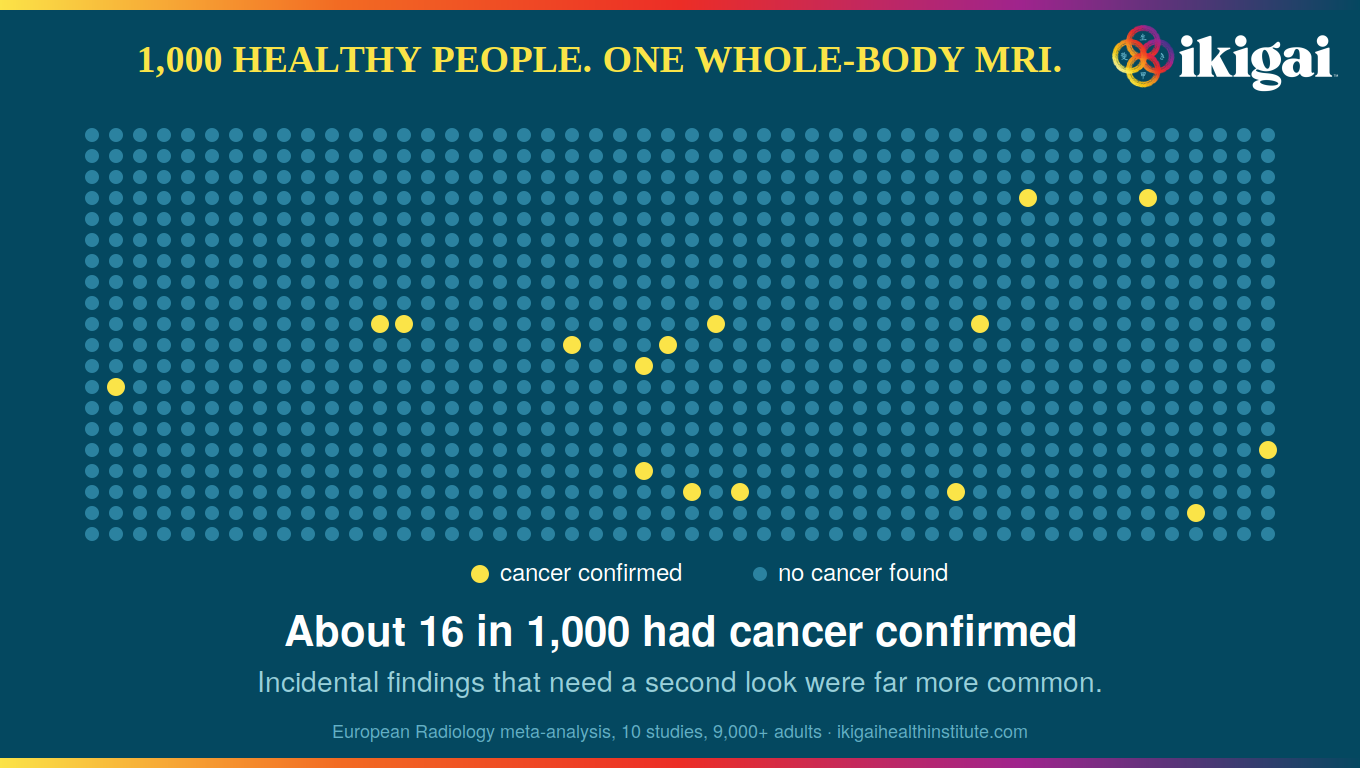
A newer analysis, published in October 2026 in the Journal of General Internal Medicine, examined 17 studies involving more than 18,000 individuals. Approximately 78% had at least one reported finding, while about 15% had a potentially actionable noncancer finding, an abnormality warranting further investigation. Among that latter group, more than half underwent additional imaging or laboratory testing, and approximately one in five underwent a subsequent procedure. The overall cancer detection estimate was 1.4%.
These results deserve perspective. Identifying cancer in approximately 14 to 16 of every 1,000 asymptomatic individuals is not insignificant, particularly when some have no established screening pathway. Likewise, actionable noncancer findings may include abnormalities warranting meaningful medical attention rather than harmless variations. Some discoveries may create opportunities to intervene before disease becomes more difficult to treat.
A 2026 expert-panel review in the American Journal of Roentgenology emphasized this broader potential while acknowledging that evidence regarding long-term outcomes remains incomplete. MRI's diagnostic capabilities are well established; what remains uncertain is how frequently those capabilities translate into better outcomes when the technology is used for broad screening. That distinction matters when assessing the benefits and limitations of whole-body MRI.
When Finding More Is Not Always Better
The human body contains countless variations that are not necessarily signs of dangerous disease. Benign cysts, small nodules, anatomical differences, and age-related changes are common. The more extensively we look, the more likely we are to encounter something unexpected.
Radiologists refer to these discoveries as incidental findings, sometimes informally called incidentalomas. Some are readily identified as harmless, while others clearly require attention. A third group falls between those extremes, where imaging cannot immediately establish whether the finding represents a meaningful health risk. Additional imaging, specialist consultation, or occasionally a biopsy may be necessary. This is where clinical judgment becomes essential: an unexpected finding should prompt thoughtful evaluation, not an automatic cascade of procedures.
There is also the problem of overdiagnosis, a concept we explored in our earlier Insights, Why Earlier Can Be Better — but More Is Not Always Better. Overdiagnosis occurs when screening identifies a genuine disease that would never have caused symptoms or shortened someone's life. This differs from a false-positive result, in which a suspicious finding ultimately proves not to be disease. Both can lead to unnecessary investigations, but overdiagnosis can also expose patients to treatment they never needed.
Finding a tumor earlier may improve the opportunity for cure, but earlier diagnosis alone does not prove someone will live longer. Researchers must account for lead-time bias, in which survival measured from diagnosis appears longer simply because the cancer was discovered sooner. They must also determine whether screening preferentially identifies slower-growing cancers that were less likely to cause harm.
Whole-body MRI avoids the radiation exposure associated with CT imaging, but uncertain findings may still lead to additional testing or anxiety. These consequences are not inevitable. Many findings can be characterized through review of prior studies, targeted noninvasive testing, or observation over time. The objective is not to investigate every abnormality aggressively, but to identify those warranting action while avoiding interventions unlikely to benefit the patient.
Why Your Personal Risk Matters
The value of screening changes when the likelihood of disease changes. This is why cancer screening recommendations differ according to age, family history, genetic predisposition, smoking exposure, and other individual risk factors. A test offering limited benefit to someone at very low risk may be considerably more valuable to someone with a substantially elevated probability of developing disease.
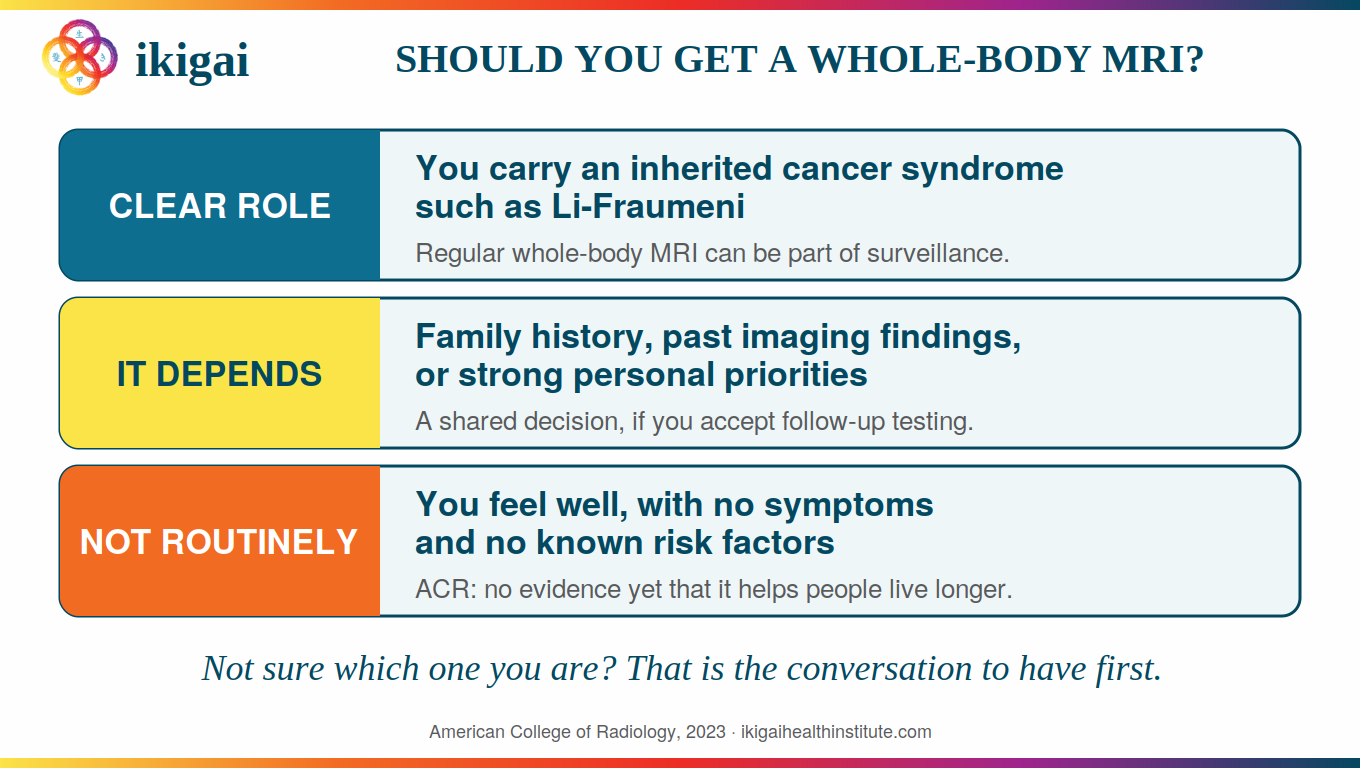
Whole-body MRI already plays an important role in surveillance for certain inherited cancer predisposition syndromes. People with Li-Fraumeni syndrome, for example, carry genetic changes that substantially increase their lifetime risk of developing several types of cancer. Because those cancers can arise in different organs and at relatively young ages, surveillance programs may incorporate regular whole-body MRI alongside other assessments.
That is a different clinical situation from offering the same examination to an asymptomatic adult without known risk factors. The technology may be similar, but the likelihood of finding meaningful disease, and therefore the balance between potential benefit and harm, is not. As we discussed in When Your Risk Changes the Rules, screening becomes more valuable when informed by an individual's underlying risk rather than applied uniformly.
For people without a recognized high-risk condition, the decision is less straightforward. Age, family history, previous imaging findings, personal health priorities, and willingness to pursue additional testing may influence whether whole-body MRI is reasonable. What we cannot currently offer is a reliable calculation showing that an otherwise healthy individual will live longer because they undergo the examination.
The American College of Radiology does not recommend routine total-body MRI screening for asymptomatic individuals without relevant risk factors, citing insufficient evidence that it improves longevity and concern about unnecessary follow-up. This distinction matters: a technology's ability to detect abnormalities is not the same as the evidence required to recommend it broadly across a population.
Whole-Body MRI Is One Tool, Not the Entire Toolkit
Established screening methods have demonstrated clinical value, but they leave substantial gaps in early cancer detection. That helps explain the interest in emerging technologies. Multicancer early detection blood tests attempt to identify biological signals associated with malignancy, potentially across several organ systems. Whole-body MRI approaches the problem differently, looking directly for anatomical abnormalities. As we discussed in Can a Blood Test Find Cancer Before It Finds You?, these technologies may expand detection beyond cancers addressed by conventional screening.
The approaches may eventually prove complementary, but combining more tests does not automatically produce better outcomes. Each has blind spots, and overlapping tests can generate findings requiring further evaluation. The goal is a thoughtful screening strategy, not simply the largest possible collection of tests.
Advanced imaging also has established applications when used to answer specific questions. Coronary CT angiography can characterize plaque in the arteries supplying the heart. Dedicated breast MRI can improve cancer detection in appropriately selected higher-risk women, while targeted pancreatic imaging may be useful in people with certain inherited predispositions. These examinations are not interchangeable with whole-body MRI, and their appropriate use depends on clinical circumstances.
The same principle applies to information obtained from some whole-body imaging programs. Measurements of visceral fat or regional brain volume may contribute to a broader health assessment, but require appropriate interpretation. A measurement is not automatically a diagnosis, and a change in a number does not necessarily represent a meaningful change in disease risk.
How We Approach Whole-Body MRI at Ikigai
At Ikigai, we offer whole-body MRI as an optional component of a comprehensive, individualized approach to preventive medicine. We believe the ability to identify certain unsuspected cancers, vascular abnormalities, and other potentially consequential findings has clinical value worth considering. At the same time, we recognize that evidence supporting routine screening of asymptomatic adults remains incomplete.
Our approach begins with understanding the individual. Family history, genetic predisposition, previous testing, age, and personal health priorities all contribute to the discussion. We explain what the examination can reasonably detect, what it may miss, and what might happen if an unexpected abnormality is discovered. Patients should understand both the opportunity for earlier diagnosis and the possibility of investigations that ultimately reveal nothing dangerous.
Just as importantly, imaging is not an isolated event. An abnormality may require comparison with prior studies, additional testing, specialist consultation, or surveillance over time. Some findings deserve prompt attention, while others require no intervention. At Ikigai, our responsibility is not simply to obtain information, but to interpret it thoughtfully, avoid unnecessary intervention, and ensure meaningful findings receive appropriate follow-through.
This is why we view whole-body MRI as one component of a larger healthspan strategy rather than a standalone answer to cancer detection. Our approach integrates established screening, individualized risk assessment, emerging technologies when appropriate, and ongoing reassessment. Preventing disease through established interventions remains at least as important as searching for it.
There is still much to learn. We do not yet know which asymptomatic populations are most likely to benefit from whole-body MRI, whether repeated examinations improve outcomes, or what screening interval, if any, provides the best balance of benefit and harm. Better studies and long-term follow-up will help answer those questions.
Knowing When to Look
Whole-body MRI offers a remarkable view of the human body without radiation and may reveal serious disease before symptoms develop. For certain cancers and other abnormalities outside established screening programs, that opportunity can be meaningful. But the most useful question is not simply how much of the body we can examine. It is whether the information we discover will help us make better decisions, prevent meaningful illness, or change the course of someone's life.
At Ikigai, we believe patients should have the opportunity to consider emerging technologies with a clear understanding of their promise and limitations. Whole-body MRI is part of that conversation, not a replacement for proven screening or a guarantee against disease. The objective remains the same: to identify meaningful risks early, act when intervention can make a difference, and use the best available evidence to support a longer, healthier life.
Take the Next Step
Wondering whether whole-body MRI makes sense for you, or whether your risk profile points to a different strategy altogether? That's exactly the conversation we have with every patient.
Schedule a Consultation — Get a personalized read on which tests make sense for your risk, and which don't.
Join the Ikigai Newsletter — Follow this series as we publish it.
Explore Our Programs — See how Ikigai integrates imaging, screening, and risk into one strategy.
Recommended Reading
- Can a Blood Test Find Cancer Before It Finds You? — The other emerging tool for cancers we don't routinely screen for.
- When Your Risk Changes the Rules — How family history, genetics, and exposures change who should consider what.
- Cancer Screening: Why Earlier Can Be Better — but More Is Not Always Better — Overdiagnosis and lead-time bias, explained.
- Cancer Screening: The Proven Playbook and Beyond — The evidence framework behind how we think about newer tests.
- Heart Tests: CAC vs. CCTA vs. CCTA with Cleerly — Another example of advanced imaging used to answer a specific question.
References
- Martins da Fonseca J, et al. Whole-body MRI for opportunistic cancer detection in asymptomatic individuals: a systematic review and meta-analysis. European Radiology, 2026;36:1813-1823.
- ACR Statement on Screening Total Body MRI. American College of Radiology, 2023.
- Whole-Body MRI Screening for Carriers of Germline TP53 Mutations: A Systematic Review and Meta-Analysis.
- Only 14% of Cancers Are Detected Through a Preventive Screening Test. NORC at the University of Chicago, Cancer Detection Tool.
The information in this post is for educational purposes only and is not intended as medical advice. Decisions about whole-body MRI and other advanced imaging should always be made with a physician who knows your personal and family history.