

A single blood draw can now flag signals from dozens of cancers, including some we never screen for, but it misses most early cancers and has not yet been shown to save lives. Galleri, a multi-cancer early detection (MCED) test, rarely raises false alarms (fewer than 4 in 1,000 people) and about 60 percent of its positive results turn out to be cancer. But it detects only about 4 in 10 cancers overall, and the largest randomized trial, NHS-Galleri, did not meet its main goal, although it showed encouraging drops in stage IV diagnoses. For now, it may complement established screening, never replace it.
What’s in this post?
- The Cancer Screening Gap
- How Cancer Leaves Clues in the Blood
- What PATHFINDER 2 Tells Us
- The NHS-Galleri Trial: A More Difficult Test
- Finding More Cancer Is Not the Same as Saving More Lives
- What Happens After a Positive Result?
- The Regulatory Landscape Is Changing
- Where Multi-Cancer Early Detection Fits at Ikigai
- A Promising Technology, an Unfinished Story
For decades, cancer screening has largely depended on knowing where to look. A mammogram examines the breast. A colonoscopy looks inside the colon. A low-dose CT scan searches the lungs of people at elevated risk. Each has helped change the outlook for patients with certain cancers, yet substantial gaps remain. Most cancers do not have an established screening test for people without symptoms, and many are discovered only after they have begun to cause problems.
Nearly 70 percent of cancer deaths in the United States occur from cancer types for which there is no established, recommended population-wide screening program. This does not mean conventional screening is ineffective. It means our proven tools address only part of the cancer landscape. As we explored in an earlier Ikigai Insights article, Cancer Screening Today: What We Find, What We Miss, a person can be fully up to date on recommended screening and still remain vulnerable to cancers those tests were never designed to find.
Imagine instead that a routine blood draw could search for signs of dozens of cancers at once, including cancers of the pancreas, ovaries, and liver. Scientists can now identify molecular traces of cancer circulating in the bloodstream, sometimes before symptoms appear, and use those signals to help determine where a cancer may be developing.
One example is Galleri, a multi-cancer early detection (MCED) test developed by GRAIL. Its arrival has generated excitement, but also a difficult question: if a blood test can find cancers that conventional screening misses, shouldn't everyone have one? Two major studies, including a randomized trial involving more than 140,000 people in England, offer reasons for optimism alongside limitations that deserve just as much attention.
The Cancer Screening Gap
Breast, cervical, colorectal, and certain lung cancers have established screening pathways supported by evidence that screening improves outcomes. For many other cancers, no comparable population-wide program exists. Pancreatic cancer may develop without obvious symptoms until it reaches an advanced stage, while ovarian cancer can produce vague symptoms that overlap with common conditions. Liver, stomach, and certain head and neck cancers present similar challenges.
In the United Kingdom, roughly 6 to 7 percent of cancers are diagnosed through screening, compared with approximately 14 percent in the United States. These figures describe how cancers are detected in practice, not how accurately individual screening tests perform. Many cancers are diagnosed after symptoms develop or through incidental findings.
The promise of multi-cancer early detection is to expand that reach. Rather than developing a separate screening procedure for every organ, researchers are attempting to identify biological signals shared by many cancers. Improving detection could represent a meaningful advance, provided that earlier diagnosis leads to better outcomes rather than simply more diagnoses.
How Cancer Leaves Clues in the Blood
Cancer cells release fragments of genetic material into the bloodstream as they grow and die. Scientists call this material cell-free DNA. Most comes from normal cells, but some may originate from a developing cancer, creating an opportunity to detect disease without knowing which organ to examine.
Galleri uses DNA methylation analysis. Methylation refers to chemical markers attached to DNA that help regulate how genes behave. Different tissues have recognizable patterns, and cancer can alter them. By examining these molecular signatures, Galleri looks for evidence of cancer and attempts to identify the tissue or organ from which the signal originated.
Galleri is a screening test, not a diagnostic test. Its purpose is to identify a possible cancer signal in someone without symptoms; a positive result does not establish that cancer is present, but prompts further evaluation. Identifying the signal's likely origin is valuable: rather than searching the entire body, physicians may have a more useful starting point, such as the pancreas, lung, or head and neck region.
Not every cancer releases enough detectable DNA into the bloodstream. Small, early cancers may produce only faint signals, while larger or more advanced cancers are often easier to detect. The technology therefore faces a biological challenge precisely where screening would ideally be most useful: finding cancers when they are still small and potentially curable.
What PATHFINDER 2 Tells Us
PATHFINDER 2 enrolled nearly 36,000 adults aged 50 and older across the United States, none with a known or suspected cancer. The study evaluated how Galleri performs in a screening population and what happens after a positive result.
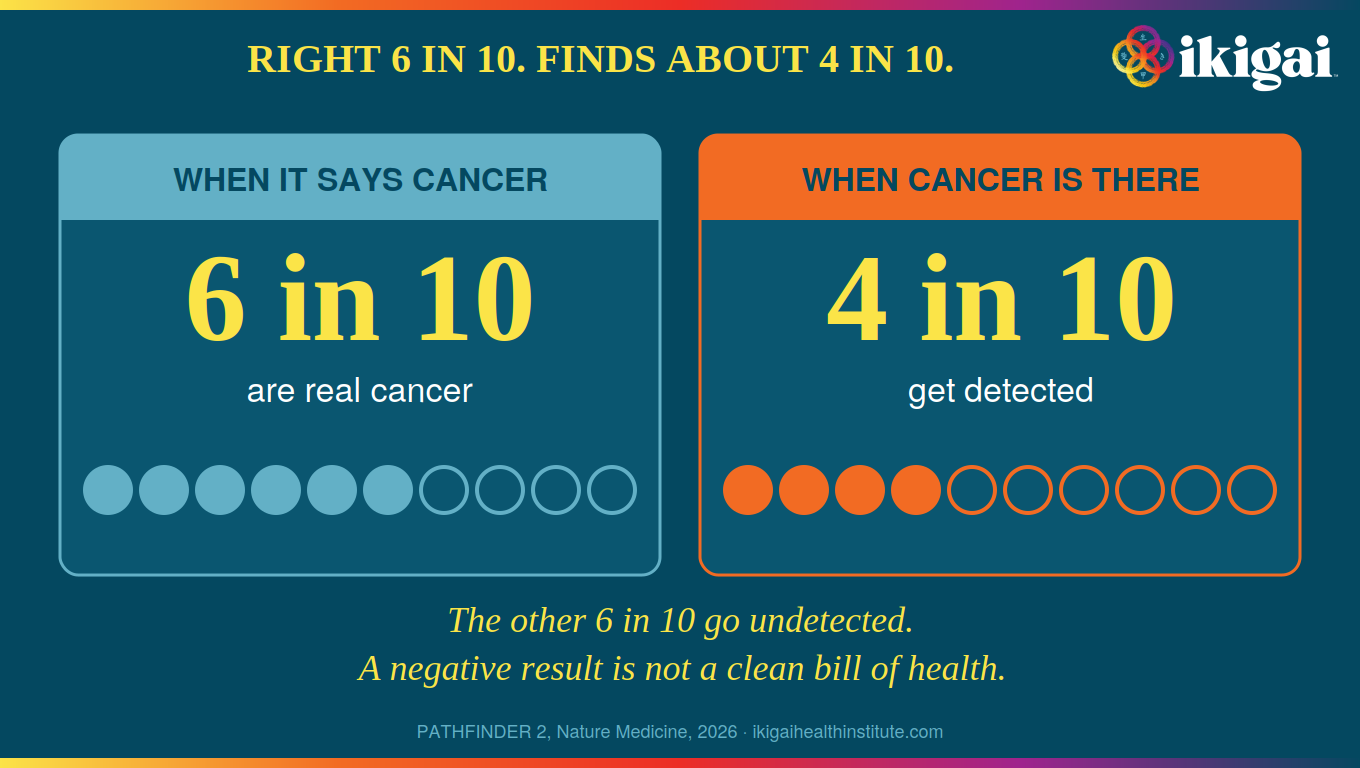
In the published analysis, researchers evaluated cancer outcomes over 12 months in approximately 32,000 participants. Of the 287 people whose blood tests suggested cancer might be present, 173 were ultimately diagnosed with the disease. Researchers call this positive predictive value: approximately 60 percent of positive results reflected a real cancer.
Galleri was also very good at avoiding false alarms. Among people without cancer, fewer than four in a thousand received a positive result. That translates to a specificity of approximately 99.6 percent, an important strength for a test intended for people who feel perfectly healthy.
But that raises another question: how often did Galleri fail to detect a cancer that was actually there? Among people diagnosed with cancer during the following year, Galleri had detected only about four in ten, or approximately 39 percent. Researchers call this sensitivity: the ability of a test to find a disease when it is present. For 12 cancer types responsible for a large share of cancer deaths, sensitivity was higher, approaching 70 percent.
The contrast is striking. When Galleri raised an alarm, it was right about six times out of ten. Yet it missed roughly six out of ten cancers diagnosed during follow-up. A negative result therefore cannot be interpreted as a clean bill of health. Routine screening and evaluation of concerning symptoms remain essential.
There was another encouraging finding. Approximately 53 percent of cancers detected through Galleri were diagnosed at stage I or II, when treatment may offer a better chance of long-term control or cure. More than two-thirds were types without established population screening recommendations. Adding Galleri also increased the number of cancers discovered through screening, although the magnitude depends on which conventional tests are included in the comparison.
Claims that Galleri increases cancer detection severalfold require context. Finding additional cancers beyond those discovered through conventional screening does not mean the test detects most cancers that develop. PATHFINDER 2 demonstrated both its reach and its limitations. Because the study was not a randomized comparison of screened and unscreened populations, it also cannot establish whether those additional diagnoses prevented advanced disease or cancer deaths.
The NHS-Galleri Trial: A More Difficult Test
PATHFINDER 2 demonstrated that Galleri could find cancers conventional screening missed. But the more difficult test was still ahead: determining whether those discoveries actually changed the course of the disease. That was the challenge facing researchers in England, who undertook one of the largest cancer screening trials ever conducted.
Working with England's National Health Service, researchers enrolled more than 142,000 adults aged 50 to 77. Participants were randomly assigned to receive annual Galleri testing alongside conventional screening or to continue conventional screening without receiving Galleri results. Researchers compared outcomes across three screening rounds.
The primary goal was to determine whether Galleri reduced the combined incidence of stage III and IV cancers among 12 selected cancer types, including pancreatic, ovarian, lung, and liver cancers. There were 706 such diagnoses in the Galleri group, compared with 688 in the control group, with no statistically significant reduction.
The results presented a puzzle. If Galleri identified more early cancers and fewer stage IV cancers, why hadn't the trial achieved its main objective? The answer lies in what happened between those two ends of the spectrum. The Galleri group had more stage III diagnoses but fewer stage IV diagnoses. Those additional stage III cancers offset the reduction in stage IV disease, leaving the combined measure essentially unchanged.
One possibility is that screening identified some cancers before they progressed to stage IV. That is encouraging, but the trial cannot establish what would have happened to individual cancers without screening or whether the shift will improve survival. The trial did not achieve its primary endpoint, so it would be inappropriate to claim that Galleri has been proven to reduce advanced cancer diagnoses overall or save lives.
Yet the findings did not end there. Researchers observed a 14 percent reduction in stage IV cancers across the 12 selected types. The difference became more pronounced during subsequent annual screening rounds, with reductions of approximately 22 percent and 26 percent during the second and third rounds. The Galleri group also experienced a 16 percent increase in stage I and II diagnoses.
These findings matter because stage IV cancer has generally spread to distant parts of the body, often limiting treatment options. A shift away from stage IV diagnoses could eventually improve survival and quality of life. But because the trial missed its primary endpoint, these encouraging secondary findings cannot be considered statistically confirmed evidence of benefit. They justify continued research rather than a declaration of success.
Repeated screening may perform differently from a single test. The first round may uncover cancers that have been developing for years, while subsequent rounds may identify newly detectable cancers before they progress. The NHS findings are consistent with that possibility, but longer follow-up is needed to determine whether the pattern changes outcomes.
Finding More Cancer Is Not the Same as Saving More Lives
The NHS trial found substantially more cancers through screening when Galleri was added to conventional methods. Researchers also reported fewer cancers diagnosed following emergency presentations. These findings suggest that MCED testing may move some diagnoses from a crisis setting into a more deliberate process of evaluation and treatment.
But finding cancer earlier does not necessarily mean treatment will be more successful. Some cancers progress so rapidly that earlier identification provides little opportunity to change their course. Others grow so slowly that they might never have caused symptoms or threatened a person's life. Screening can identify both, sometimes exposing people to treatment they would not otherwise have needed.
We explored these challenges in Why Earlier Can Be Better — but More Is Not Always Better, including lead-time bias. Discovering cancer earlier can make survival after diagnosis appear longer even when a person's lifespan is unchanged. This is why counting additional diagnoses is not enough to demonstrate that screening helps people live longer, healthier lives.
The NHS trial's randomized design helps separate screening's effects from biases that complicate observational studies. Its mixed findings remind us why carefully designed trials matter. The ultimate measure of success is whether screening leads to fewer deaths, less suffering, or better quality of life without disproportionate harm.
What Happens After a Positive Result?
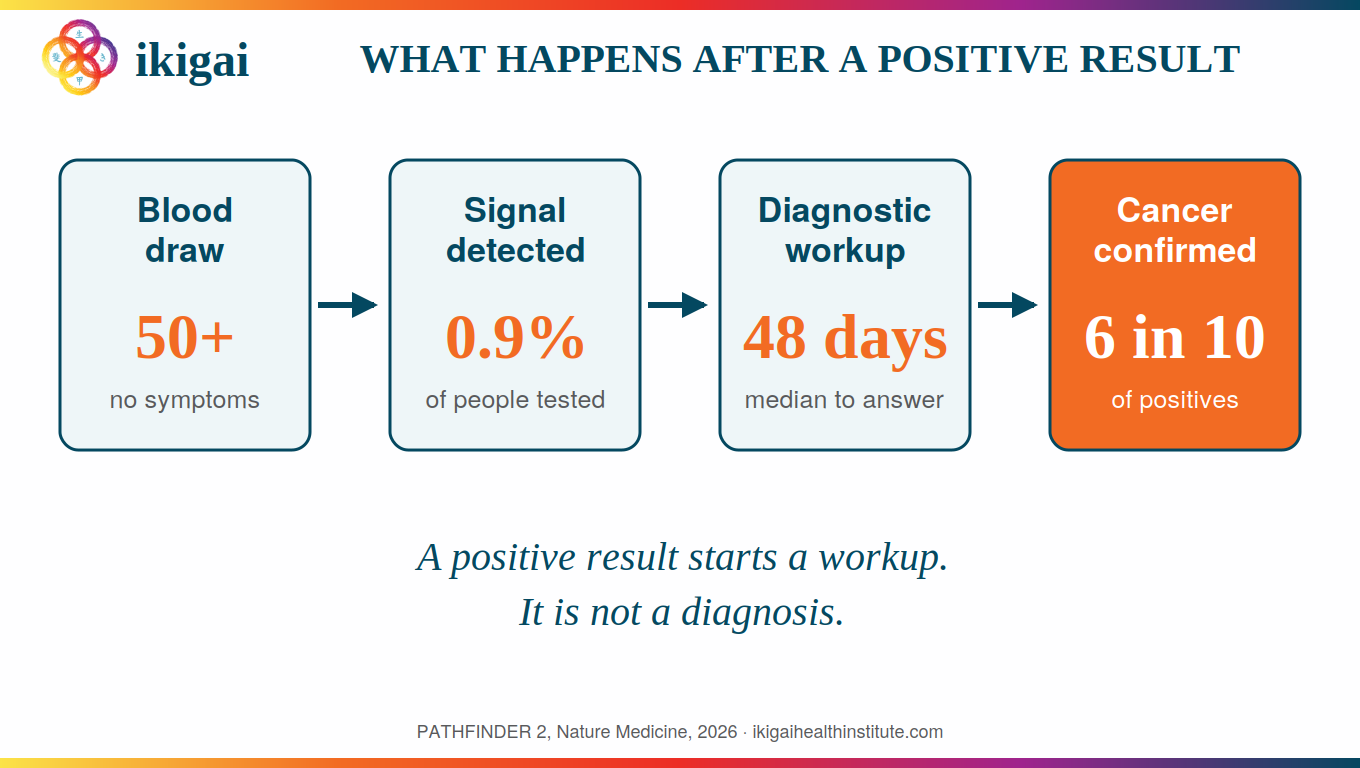
The blood draw is the easy part. What follows a positive result may be considerably more involved. Galleri is a screening test, so a positive result begins a diagnostic process rather than establishing a cancer diagnosis. Imaging, endoscopy, biopsy, or other procedures may be needed to determine whether cancer is present.
In PATHFINDER 2, Galleri correctly predicted the likely origin in approximately 91 percent of participants ultimately diagnosed with cancer. The median time to diagnostic resolution was 48 days, with evaluations generally taking longer when no cancer was identified. Approximately 0.6 percent of all tested participants underwent an invasive procedure following a positive result; most evaluations were noninvasive. No serious study-related adverse events were reported at the initial data cutoff, although GRAIL subsequently identified one serious adverse event associated with diagnostic evaluation after that cutoff.
These findings are reassuring, but they do not eliminate the burden of follow-up testing. Imagine being told that a blood test detected a molecular signal associated with cancer, yet initial imaging found nothing. Further evaluation or observation may be recommended, with no immediate way to resolve the uncertainty. For some people, that uncertainty is manageable; for others, it can affect daily life even when no cancer is ultimately diagnosed.
The reverse situation carries its own risk. A negative result may feel reassuring, particularly when a test searches for signals associated with more than 50 cancers. Yet sensitivity varies substantially by cancer type and stage. Persistent symptoms warrant evaluation regardless of the result, and a negative test should never replace a mammogram, colonoscopy, or other recommended screening.
The Regulatory Landscape Is Changing
Galleri has been offered in the United States as a laboratory-developed test rather than through the traditional FDA approval pathway. That may be changing. GRAIL submitted a premarket approval application in January 2026, and on September 23, 2026, an FDA advisory panel voted 10 to 0 that the test is safe, 6 to 4 that it is effective, and 7 to 2, with one abstention, that its benefits outweigh its risks. The panel did not vote on approval itself, and the FDA is not bound by its recommendation; a final decision is expected in the coming months. Panel members also acknowledged that there is still no proof that the test reduces cancer mortality.
FDA review must be distinguished from final authorization. Regulatory decisions may clarify the test's intended use, but they will not necessarily resolve which patients benefit, how often screening should occur, or whether testing reduces cancer mortality.
Other multi-cancer early detection technologies are in development, and their performance may differ by cancer type and stage. Continued research will help determine which approaches offer meaningful clinical benefit.
Where Multi-Cancer Early Detection Fits at Ikigai
At Ikigai Health Institute, cancer screening begins with the individual rather than any single test. Two people of the same age may have very different cancer risks, screening histories, and reasons to consider an emerging test. As we discussed in Cancer Risk Is Personal and When Your Risk Changes the Rules, family history, inherited risk, environmental exposures, and prior screening results all shape that assessment.
MCED is particularly interesting because it addresses a genuine weakness in conventional screening. We cannot perform a colonoscopy of the pancreas or a mammogram of the liver, and there is no practical way to image every organ frequently enough to guarantee that an emerging cancer will be found. A blood test capable of surveying multiple tissues offers a different approach that may eventually complement conventional screening.
For now, the decision to use Galleri deserves an individualized discussion. We consider the evidence, overall cancer risk, the test's limitations, and the possibility of additional investigations. It is one potential component of a broader strategy, not a replacement for established screening or clinical judgment.
Cancer screening is not a one-time event. Risk changes, recommendations evolve, and new evidence can alter practice. A thoughtful program must ensure that abnormal findings are investigated and recommended screening does not fall through the cracks. That coordination is as important as selecting any individual test, a principle underlying the screening playbook we have developed throughout this series.
A Promising Technology, an Unfinished Story
Multi-cancer early detection has crossed an important scientific threshold. A single blood draw can identify molecular signals associated with cancers throughout the body, direct physicians toward their likely source, and detect some cancers conventional screening would not otherwise find. Large studies demonstrate these capabilities with relatively low false-positive rates.
What remains uncertain is whether they translate into the outcomes patients care about most. The NHS-Galleri trial did not demonstrate a reduction in its primary measure of advanced cancer, but it revealed encouraging changes in stage IV diagnoses. PATHFINDER 2 demonstrated useful test performance while showing that many cancers remain undetected. Longer NHS follow-up is expected to provide evidence about cancer-specific mortality and overdiagnosis, helping researchers assess the net benefit.
The challenge now is to determine which patients benefit, which cancers are most effectively detected, and whether earlier diagnosis leads to longer, healthier lives. Those answers will emerge through continued research, not enthusiasm alone. In the meantime, effective cancer screening remains a combination of established evidence, individualized risk assessment, thoughtful use of emerging tools, and consistent follow-through.
The promise of a blood test that can search for dozens of cancers is compelling. The responsibility of preventive medicine is to make sure that what we find genuinely helps the people we are trying to protect.
Take the Next Step
Wondering whether a test like Galleri belongs in your own screening strategy — or whether your risk profile points somewhere else entirely? That's exactly the conversation we have with every patient.
Schedule a Consultation — Get a personalized read on where emerging tests fit, and where established screening still comes first.
Join the Ikigai Newsletter — Follow this series as we publish it.
Explore Our Programs — See how Ikigai integrates screening, risk, and emerging technology into one strategy.
Recommended Reading
Cancer Screening: The Proven Playbook—and Where We Go Beyond It — The evidence framework behind how we think about tests like Galleri.
Cancer Screening: Why Earlier Can Be Better — but More Is Not Always Better — Lead-time bias and overdiagnosis, the traps in counting extra diagnoses.
When Your Risk Changes the Rules — How family history, genetics, and exposures change who should consider what.
Cancer Risk Is Personal: Building Your Cancer Risk Profile — Why screening should start with the individual, not the test.
Cancer Screening Today: What We Find, What We Miss — The series opener, on the gap multi-cancer tests are trying to close.
References
Nabavizadeh N, McDonnell C, Kurbegov D, et al. Performance and safety of a multi-cancer early detection test: the PATHFINDER 2 study. Nature Medicine, 2026.
Galleri Early Detection Test May Shift Timing of Cancer Detection, Reducing Stage IV Diagnoses. American Society of Clinical Oncology, 2026.
Galleri MCED Test Does Not Reduce Stage III/IV Cancer Diagnoses but May Have Other Clinical Utility. Cancer Therapy Advisor, 2026.
FDA Advisory Committee Votes in Favor of Approval of Multi-Cancer Early Detection Test. The ASCO Post, September 2026.
FDA Panel Votes on Grail's Multicancer Test, Highlights Data Gaps. Medscape, September 2026.
Only 14% of Cancers Are Detected Through a Preventive Screening Test. NORC at the University of Chicago, Cancer Detection Tool.
Cancer in the UK 2026: cases exceed 400,000 for the first time. Cancer Research UK, April 2026.
The information in this post is for educational purposes only and is not intended as medical advice. Decisions about multi-cancer early detection testing should always be made with a physician who knows your personal and family history.