

Cancer screening guidelines are the foundation of a good cancer strategy — but not always its ceiling. Guideline-recommended screening for breast, cervical, colorectal, and lung cancer rests on decades of evidence and should be completed first. But most cancer deaths come from cancers with no routine screening test, which is why prevention, personalized risk assessment, and emerging tools like multi-cancer blood tests can reasonably extend a strategy beyond the guidelines — as long as that extension is still built on evidence, not just on what technology makes possible.
What's in this post?
- A Cancer Playbook Shouldn't Begin With Cancer
- Evidence Isn't Simply "Proven" or "Unproven"
- What a Blood Test for Many Cancers Can — and Cannot — Tell Us
- When a "Negative" Trial Is More Interesting Than the Headline
- Guidelines Establish a Floor. They Don't Always Establish a Ceiling.
- Beyond Guidelines Cannot Mean Beyond Evidence
- The Ikigai Playbook
For decades, cancer screening has largely meant a familiar list: mammograms, colonoscopies, cervical cancer screening, and, for some people with a significant smoking history, low-dose CT scans of the lungs. These tests matter. They have earned their place because evidence shows that, when used in the right people at the right intervals, they can prevent cancers, find them earlier, or reduce the likelihood of dying from them. They form the foundation of a thoughtful cancer strategy.
But they also leave an uncomfortable amount of cancer untouched. Many cancers that cause substantial illness and death have no routinely recommended population screening test. Pancreatic cancer. Ovarian cancer. Liver and bile duct cancers. Brain tumors. Many blood cancers. The list is long. In fact, most cancer deaths occur from cancer types for which we do not have recommended routine population screening.
That gap in conventional cancer screening — the blind spot we explored at the beginning of this series — creates a tension at the center of modern cancer prevention. We have a group of screening strategies supported by decades of evidence, but we also know those strategies cannot find most cancers before they announce themselves. As technology gives us new ways to assess risk and search for disease, what should we do with everything outside the established playbook?
At Ikigai, our answer is not to abandon guidelines, nor is it to order every available cancer test simply because technology makes it possible. We start with what is proven, try to understand an individual's risk, move upstream whenever we can prevent disease rather than merely detect it, and selectively consider newer tools when the evidence and the patient's circumstances make a reasonable case for doing so. Sometimes that takes us beyond conventional screening recommendations.
The important question is whether we can explain why. What does "proven" actually mean?
Cancer screening guidelines are sometimes treated as though they are merely conservative checklists. That sells them short. Recommendations for breast, cervical, colorectal, and lung cancer screening rest on decades of research into who benefits, when screening should begin, how often it should occur, and what harms screening can create. Some approaches can do more than find cancer early. Colonoscopy can identify and remove precancerous polyps before they become colorectal cancer. Cervical screening can identify precancerous changes that can be treated before invasive cancer develops.
For an average-risk person, these recommendations provide an evidence-based starting point, and one of the simplest ways to improve cancer outcomes remains decidedly unglamorous: make sure people actually complete the screening we already know works. But population guidelines are designed to answer a population question: what should broadly be recommended to millions of people when we consider benefit, harm, cost, feasibility, and the quality of available evidence?
As we explored in Cancer Risk Is Personal, population averages can only take us so far. The question becomes different when the person sitting in front of us is no longer an average. What should we consider for someone with several relatives who developed the same cancer at unusually young ages? What about someone with decades of tobacco exposure, a pathogenic genetic variant, a previous precancerous lesion, or a significant occupational exposure? Two people can be the same age and sex and have meaningfully different cancer risk.
This is where guidelines become the foundation of a cancer strategy rather than necessarily its ceiling. That isn't an argument against guidelines. It is an acknowledgment that a recommendation designed for an entire population and a decision made with an individual patient are related, but not identical, exercises.
A Cancer Playbook Shouldn't Begin With Cancer
Cancer medicine naturally draws our attention toward detection. Find the tumor. Find it small. Find it before it spreads. In Cancer Screening: Why Earlier Can Be Better — but More Is Not Always Better, we explored why that instinct is generally sound but incomplete. Earlier detection matters when it creates an opportunity to change what happens next.
But there is an even earlier opportunity. Sometimes we can reduce the chance that the cancer develops in the first place.
Some examples are familiar. Tobacco exposure increases the risk of multiple cancers. Excessive ultraviolet radiation contributes to skin cancer. Alcohol increases the risk of several cancers. HPV vaccination can prevent infections responsible for cervical and several other cancers. Other opportunities receive much less attention, in part because they do not look like what we traditionally think of as "cancer screening."
Consider Helicobacter pylori, or H. pylori, a bacterium that can chronically infect the stomach. Most people who carry it will never develop stomach cancer, but the causal connection is unusually strong: H. pylori is classified as a definite human carcinogen and is responsible for a substantial proportion of gastric cancers worldwide. In randomized trials and long-term population studies, eradication of the infection has reduced subsequent gastric cancer incidence in the populations studied.
Testing for H. pylori is not cancer screening. It doesn't tell us whether someone has stomach cancer. It identifies a modifiable carcinogenic exposure that may be present years before cancer develops. If the infection is present and appropriately treated, we may be able to lower future cancer risk rather than simply search for the cancer earlier.
This distinction matters because it expands the playbook. A thoughtful cancer strategy isn't only about looking for tumors. It also asks whether we can identify inherited susceptibility, eliminate carcinogenic exposures, treat cancer-promoting infections, remove precancerous tissue, or change other modifiable risks before invasive disease ever appears.
The evidence also illustrates why personal risk matters. Eradicating H. pylori appears to reduce gastric cancer risk substantially in studied populations, but the absolute benefit is not identical for everyone. A person whose baseline gastric cancer risk is higher because of family history, ancestry, previous gastric pathology, or other relevant factors has more potential to gain from the same intervention than someone whose baseline risk is very low. This is one reason targeted testing can make sense even when population-wide testing of every average-risk American is not recommended.
The intervention hasn't changed. The person has.
Evidence Isn't Simply "Proven" or "Unproven"
That brings us to a more difficult part of modern cancer prevention. Medicine understandably places enormous weight on randomized controlled trials showing that an intervention improves an outcome that matters — ideally preventing advanced disease or reducing cancer mortality. When that evidence exists, it should carry substantial weight. But cancer develops over years or decades, and trials designed to prove a mortality benefit may require enormous populations and very long follow-up. New technologies can evolve several times while the definitive outcomes study is still underway.
That doesn't mean we lower the evidentiary bar until anything qualifies. It means we need to become more precise about what has actually been demonstrated.
Imagine a new blood test designed to detect cancer. There isn't just one question to answer. Can it reliably detect a biological signal associated with cancer? Can it distinguish people with cancer from people without it? If it detects a signal, can it tell clinicians where to look? Can it find cancer before symptoms develop? Does it find consequential cancers at earlier stages? Does using it reduce the number of people who eventually present with metastatic disease? And ultimately, do people screened with it live longer or die less often from cancer?
Those questions form a progression. Evidence supporting one does not automatically prove the next. But evidence supporting the earlier questions isn't meaningless simply because the final question remains unanswered. This is a distinction worth stating plainly: the strength of our recommendation should match the strength of the evidence. But the absence of population-level mortality data does not require us to pretend that all other evidence is meaningless.
Few technologies illustrate that tension better than multi-cancer early detection testing.
What a Blood Test for Many Cancers Can — and Cannot — Tell Us
The Galleri multi-cancer early detection test, or MCED, looks for patterns of methylation in cell-free DNA circulating in the bloodstream. Methylation refers to small chemical tags attached to DNA that help regulate how genes behave. Cancer cells can shed fragments of DNA into the blood, and the pattern of these tags can differ from that of normal cells. The attraction is obvious. Conventional screening searches for a handful of cancers, usually one organ at a time. Could one blood draw help identify multiple cancers — including cancers for which we currently have no routine screening test?
The emerging data are genuinely interesting. In PATHFINDER 2, more than 35,000 adults age 50 and older underwent MCED testing and were followed for cancer diagnoses. The test rarely raised a cancer alarm in someone who did not ultimately have cancer: fewer than 4 out of every 1,000 people tested had a false alarm. When the test did detect a cancer signal, about 60% of those people were ultimately diagnosed with cancer. The test also reached beyond the cancers we routinely screen for. About two-thirds of the cancers it detected were types for which we do not have established routine screening, and 53% of newly detected primary cancers were stage I or II.
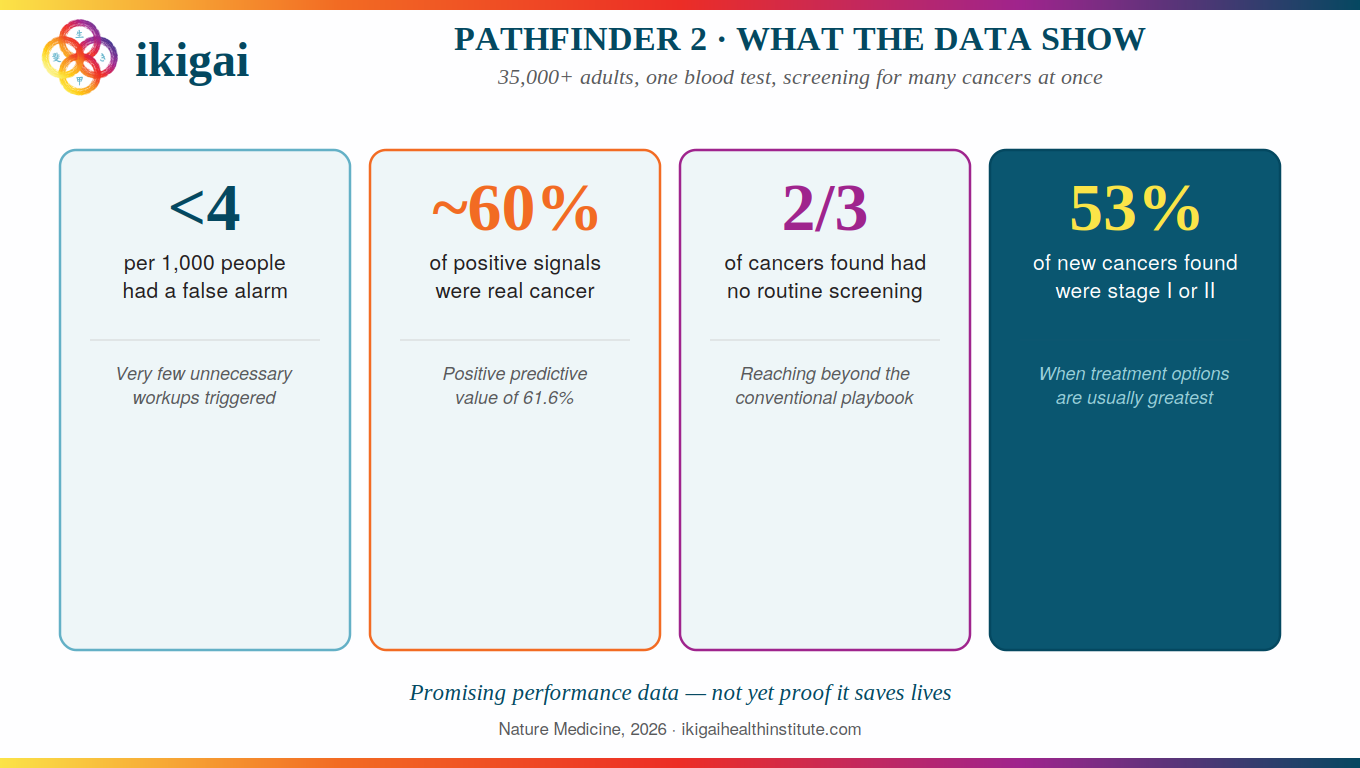
There is an important limitation, however: MCED testing is much less sensitive at the very earliest stages of cancer, with validation studies detecting only about 17% of stage I cancers and sensitivity rising substantially as cancers advance. Those findings should not be dismissed. But neither should they be confused with the question we ultimately care about: does testing asymptomatic people with MCED prevent cancer deaths? We don't yet know.
When a "Negative" Trial Is More Interesting Than the Headline
The NHS-Galleri trial provides a remarkable real-world example of why evidence rarely fits neatly into a yes-or-no box. More than 142,000 adults in England were randomized to an intervention group offered three rounds of MCED testing or to a control group. The study's primary endpoint was not mortality. Researchers asked whether MCED screening would reduce the incidence of stage III and IV cancers among 12 prespecified cancer types.
The trial did not meet that primary endpoint. After three screening rounds, there was no significant reduction in the combined incidence of stage III and IV cancers. Read only that headline and it would be easy to conclude that the technology failed.
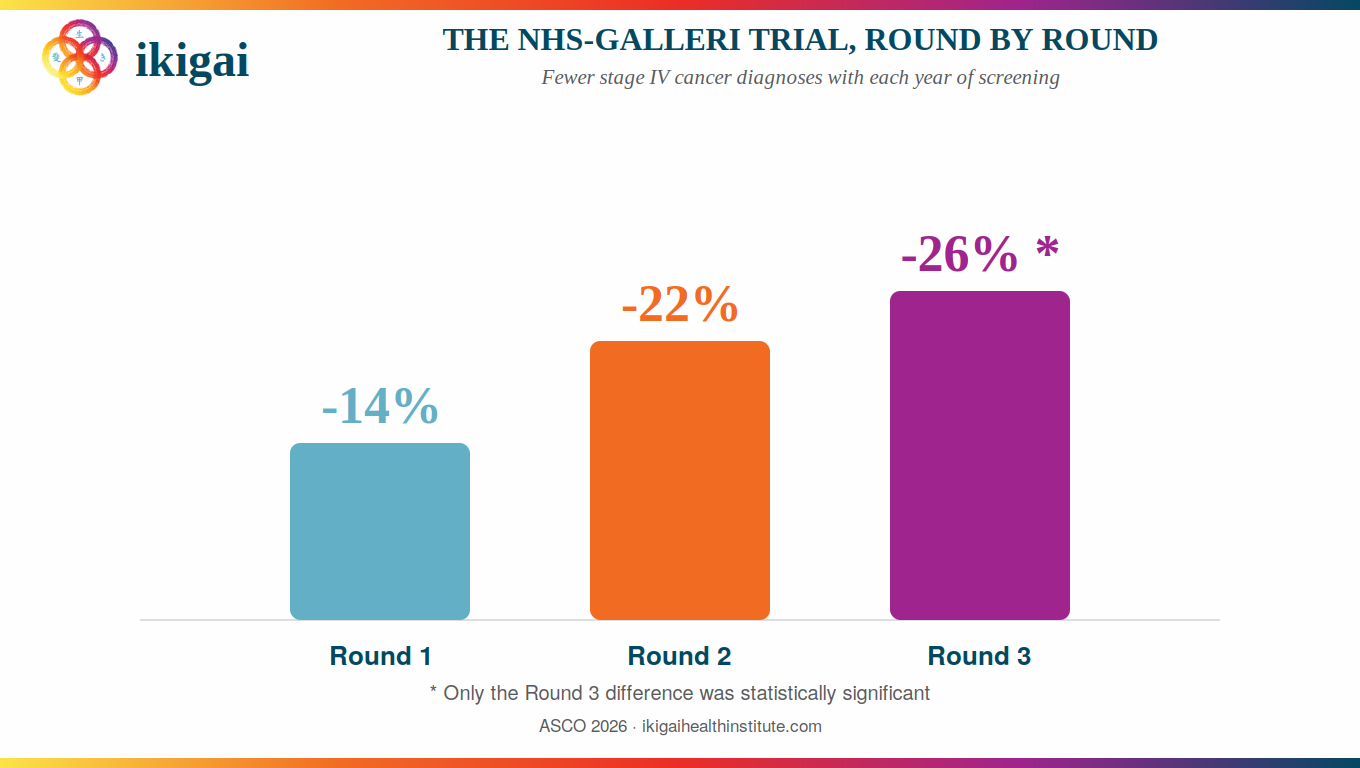
Look more closely, however, and the story becomes more interesting. Across the three rounds of screening, there were 14% fewer stage IV cancers among people offered the Galleri test. Why does that matter? Stage IV generally means a cancer has spread to distant parts of the body, where treatment becomes more difficult and the likelihood of cure is often much lower. If screening can find some of those cancers earlier — before they reach stage IV — that could ultimately matter far more than simply finding more cancers. The difference appeared to grow with repeated screening: there were 22% fewer stage IV cancers in the second round and 26% fewer in the third, although only the third-round difference was large enough for researchers to be confident it was unlikely to be due to chance. At the same time, more cancers were being found at stage III. That helps explain the seemingly contradictory headline result: when stages III and IV were counted together, there was no overall reduction. Underneath that combined number, however, there were more stage III cancers and fewer stage IV cancers.
Other signals pointed in the same potentially encouraging direction. Stage I–II detection among the prespecified cancers increased by 16%, and fewer cancers in the intervention group were diagnosed after presenting as emergencies. Yet the stage IV findings also varied substantially by cancer type, and pancreatic and ovarian cancers did not show the favorable pattern seen with several others.
This is exactly the problem of lead-time bias and overdiagnosis we explored in our previous article on early cancer detection. Finding more cancers at earlier stages can mean we are successfully intercepting dangerous cancers before they spread. It can also reflect lead-time bias — starting the diagnostic clock earlier without changing the ultimate outcome — or overdiagnosis of cancers that would never have caused harm. A reduction in stage IV disease is the direction we hope to see if screening is truly changing the natural history of cancer, but NHS-Galleri has not yet established that people screened with MCED live longer.
So was the trial a failure? That is too simplistic. Did it prove MCED saves lives? It did not. The scientifically interesting answer lives between those statements.
Guidelines Establish a Floor. They Don't Always Establish a Ceiling.
No major U.S. guideline organization currently recommends MCED testing as routine population screening, and no completed randomized trial has yet demonstrated that MCED screening reduces cancer-specific or all-cause mortality. That uncertainty deserves to be stated plainly.
But there is another side to the decision. Most cancers detected by MCED in the prospective studies are cancers for which we don't have conventional screening. Waiting for definitive mortality data is entirely appropriate before recommending MCED screening to an entire population. Whether every individual should necessarily wait for that same endpoint before even considering the technology is a different question.
This is where population medicine and precision medicine can develop some healthy tension. Population guidelines must ask whether an intervention should be recommended broadly to millions of people, including people at very low baseline risk, while accounting for false positives, downstream procedures, costs, and uncertain benefits. In clinical practice, we may instead be asking whether the same test is reasonable for one 60-year-old whose age, family history, previous cancer, genetic findings, or exposures produce a very different baseline risk.
"Not recommended for everyone" is not the same as "appropriate for no one." But the reverse is equally important: the fact that a technology can find cancer does not mean everyone should be screened with it. At Ikigai, this is where clinical judgment begins rather than ends.
Beyond Guidelines Cannot Mean Beyond Evidence
Moving beyond established recommendations should make us more rigorous about evidence, not less. Before using an emerging test, we should understand what it detects, what it misses, how often a positive result represents real disease, what diagnostic process follows an abnormal result, what harms that process can create, and whether there is a plausible path by which learning the information earlier could change an outcome.
The downstream pathway matters. In PATHFINDER 2, only a small fraction of all participants underwent an invasive procedure after a positive result, which is reassuring. But people with positive signals still entered a diagnostic process that could involve imaging, specialist consultation, endoscopy, or biopsy, and resolution could take weeks. A sophisticated cancer program therefore cannot simply order sophisticated tests. Someone has to interpret the result in context, decide what should happen next, ensure that it happens, and manage the uncertainty when the answer is not immediately clear.
This same discipline applies well beyond MCED. The evidence for H. pylori and gastric cancer is not the same kind of evidence as the evidence for a blood-based cancer detection test. Genetic risk assessment answers yet another question. Imaging introduces different strengths and harms. None should be labeled simply "proven" or "unproven" without asking: proven to do what?
That may be the most important question in the modern cancer playbook.
The Ikigai Playbook
We are intentionally aggressive about cancer risk reduction and early detection. We make no apology for that. Conventional screening leaves too much cancer outside its reach, and we believe a modern healthspan practice should be willing to consider what lies beyond the minimum when the science and the individual's risk justify doing so.
But aggressive does not mean indiscriminate. Our approach begins with established screening and making sure it actually gets done. It moves upstream to understand inherited risk, exposures, and modifiable contributors before cancer develops. It uses risk to determine where additional attention may be warranted. It considers emerging technologies without pretending uncertainty has disappeared. And when something abnormal is found, it tracks the finding through the diagnostic process rather than treating the screening test itself as the accomplishment.
Some parts of that strategy rest on decades of outcome data. Other parts are developing in real time. We should neither pretend those evidence levels are equivalent nor assume that everything outside current population guidelines belongs in the same bucket.
Our previous discussion of early detection showed two very different possibilities. In one, screening simply moved the diagnosis earlier while the person's lifespan remained unchanged. In the other, finding disease earlier created an opportunity to change the trajectory.
Modern cancer prevention lives in the space between those two pictures. Sometimes we have decades of evidence showing that an intervention changes outcomes. Sometimes we have strong causal evidence that removing a risk can prevent disease. Sometimes we have compelling evidence that a technology can find cancer earlier while we wait to learn whether that earlier detection ultimately saves lives.
The challenge is knowing which situation we are in — and being honest about it.
Because the goal of the cancer playbook is not to order the most tests or collect the most information. It is to use the best evidence available, understand the individual in front of us, and intervene at a point when we still have an opportunity to change what happens next.
Take the Next Step
Wondering whether an emerging test like Galleri makes sense for you specifically — or whether your risk profile justifies a different strategy than the standard guidelines? That's exactly the conversation we have with every patient.
Schedule a Consultation — Get a personalized read on where your strategy should extend beyond the guidelines, and where it shouldn't.
Join the Ikigai Newsletter — Follow this series as we publish it over the coming months.
Explore Our Programs — See how Ikigai integrates proven screening, prevention, and emerging technology into one strategy.
Recommended Reading
Cancer Screening: Why Earlier Can Be Better — but More Is Not Always Better — The lead-time bias and overdiagnosis concepts referenced throughout this post.
Cancer Risk Is Personal: Building Your Cancer Risk Profile — Why population averages can only take a screening strategy so far.
Cancer Screening Today: What We Find, What We Miss — The series opener, on the gap this post picks back up.
References
The information in this post is for educational purposes only and is not intended as medical advice. Decisions about screening beyond established guidelines should always be made with a physician who knows your personal and family history.



Stop guessing. Start optimizing.
You have a strategy for your wealth and your career. It's time to build one for your health.