

Cancer screening starts with proven guidelines, but family history, genetics, prior findings, and exposures can change the plan. Learn when higher risk calls for earlier or different screening—and why more testing is not always better.
What’s in this post?
- Average Risk Is a Starting Point
- Family History Is More Than a Checkbox
- When Genetics Changes the Map
- Your Own Medical History Can Change the Rules, Too
- Exposure Can Create Risk That Age Alone Cannot See
- Higher Risk Does Not Mean More Testing Everywhere
- The Risk Profile Should Not Sit Still
- Personalized Does Not Mean Improvised
Cancer screening guidelines are built around a deceptively simple question: What should we recommend for a large group of people who are generally healthy and have an average risk of developing a particular cancer? That is an important question. It is also not always the question that matters most for you.
A 52-year-old woman whose mother and sister both developed breast cancer at young ages is not necessarily playing by the same rules as another 52-year-old woman without that family history. A 48-year-old man whose father developed colon cancer at 46 may need a different colorectal cancer screening plan than his neighbor. Someone who smoked for decades may qualify for lung cancer screening that would offer little benefit to a lifelong nonsmoker. And a person who carries an inherited genetic change known to increase cancer risk may need surveillance for cancers that we do not routinely screen for at all in the general population. The difference is risk.
Earlier in this series, in Cancer Risk Is Personal: Building Your Cancer Risk Profile, we explored the idea that cancer risk is not a single number. It is assembled from many pieces: age, family history, genetics, prior medical findings, environmental exposures, behaviors and sometimes information we are still learning how to interpret. Most people will never have one dramatic finding that defines their cancer risk. Instead, the picture emerges as those pieces are put together.
That matters because cancer screening guidelines are not universal laws. They are carefully constructed recommendations designed to balance benefit and harm across populations. Once an individual's risk moves far enough away from the population those guidelines were designed for, the balance can change. Screening may need to begin earlier, happen more frequently, use a different test or, in selected circumstances, look for a cancer that would not ordinarily be screened for at all. The challenge is knowing when risk has changed the rules—and when it hasn't.
Average Risk Is a Starting Point
Most familiar cancer screening recommendations begin with age. Colorectal cancer screening starts around a certain age. Mammography enters the conversation around a certain age. Cervical cancer screening follows an age-based schedule. Lung cancer screening is recommended only for people who meet specific age and smoking-history criteria. There is good reason for this. Age is one of the strongest risk factors for cancer, and population-based recommendations need clear thresholds. But age is only one variable. Two people celebrating the same birthday can have substantially different risks of developing the same cancer.
This is where guidelines meet the individual. A screening recommendation essentially asks whether finding a cancer earlier, across a defined group of people, is likely to improve outcomes enough to justify the downsides of screening. Those downsides include false alarms, additional imaging, biopsies, procedures, radiation exposure, overdiagnosis, cost and anxiety. When the underlying probability of cancer rises, however, that calculation can shift. A test that produces too many false positives to justify using it broadly may become more reasonable in a carefully selected higher-risk population.
In The Proven Cancer Screening Playbook, we laid out the screening strategies with the strongest evidence behind them. Those recommendations remain the foundation. Personalized screening should not mean abandoning proven screening in favor of an ever-expanding collection of tests. It means starting with the evidence-based playbook and then asking a second question: Is there something about this particular person's risk that should change it? Sometimes the answer is yes.
Family History Is More Than a Checkbox
Most medical forms ask whether cancer runs in your family. Unfortunately, a checkbox labeled "family history of cancer" tells us surprisingly little. What matters is the pattern: Which relative developed cancer? What type? At what age? Was it one cancer or several? Did multiple cancers occur on the same side of the family? Were there unusual combinations, such as breast and ovarian cancer, colon and endometrial cancer, or pancreatic and prostate cancer? Did someone develop a cancer much younger than we would ordinarily expect?
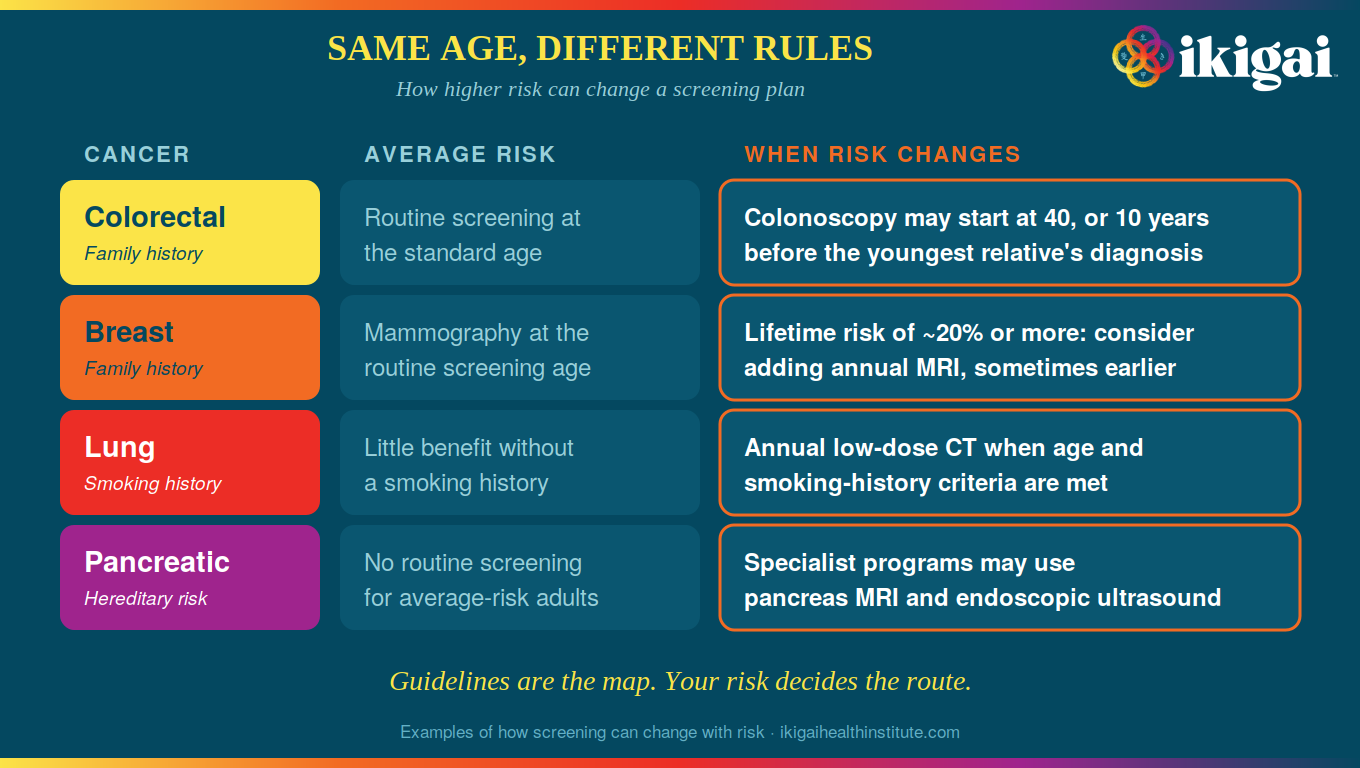
Consider colorectal cancer. For someone at average risk, routine screening can begin at the standard recommended age. But a first-degree relative—a parent, sibling or child—with colorectal cancer can change the recommendation, particularly when that cancer occurred at a younger age. Depending on the family history, colonoscopy may begin at age 40, or 10 years before the age at which the youngest affected relative was diagnosed, and may be repeated more frequently than it would for someone at average risk. The important information, then, is not simply "Dad had colon cancer." It is "Dad was diagnosed with colon cancer at 46." Those extra details can materially change a screening plan.
Breast cancer provides another example. A woman's screening strategy may change when her estimated lifetime breast cancer risk rises because of family history and other factors. For example, when a woman's estimated lifetime risk of breast cancer reaches roughly 20 percent or more, doctors commonly consider adding annual breast MRI to mammography. That number should not be interpreted as a biological dividing line between “high” and “low” risk; risk models are tools, not precise predictions. But when estimated risk rises substantially above average, mammography alone may no longer be the preferred strategy, and screening may begin at a younger age than routine screening would otherwise start.
Notice what is happening in both examples. The goal has not changed. We are still trying to find clinically important cancer early enough to improve the chance of successful treatment. What has changed is the probability of disease, and therefore the point at which the potential benefit of additional screening begins to outweigh its harms.
Family history is also dynamic. A risk assessment performed at 45 is not necessarily valid forever. Your sister may be diagnosed with breast cancer at 51. Your father may develop pancreatic cancer at 72. A cousin's genetic testing may uncover an inherited genetic change that suddenly explains a pattern of cancers scattered across generations. Nothing changed in your DNA that day, but what we know about your risk did. That is why family history should be revisited, not simply collected once and buried in a medical record.
When Genetics Changes the Map
Sometimes a family history leads to another question: Is there an inherited reason these cancers are occurring? Most cancers are not caused by a single inherited genetic change. But some cancers arise in people who inherited changes in genes that substantially increase susceptibility to particular cancers. BRCA1 and BRCA2 are among the best known, and Lynch syndrome is another important example, but dozens of inherited genetic changes can affect cancer risk.
A genetic result can therefore do something unusually powerful: it can change the screening map before cancer appears. For someone with a sufficiently high inherited breast cancer risk, screening may start earlier and include MRI in addition to mammography. Lynch syndrome can lead to substantially earlier and more frequent colonoscopy than population guidelines recommend. Certain inherited syndromes may prompt surveillance for additional cancers based on the gene involved and the individual's family history.
Pancreatic cancer illustrates just how dramatically the rules can change. We do not recommend routine pancreatic cancer screening for average-risk adults. There is no pancreatic equivalent of the routine mammogram or colonoscopy. The disease is uncommon enough, and our screening tools imperfect enough, that screening millions of average-risk people would create substantial potential for false positives, incidental findings and unnecessary procedures.
But move into a carefully defined high-risk population—certain hereditary cancer syndromes or strong familial clusters of pancreatic cancer—and the equation changes. Specialized programs may use MRI designed to closely examine the pancreas and its ducts, sometimes combined with endoscopic ultrasound to look for early cancers or concerning precursor lesions. The evidence is still developing, and this kind of surveillance belongs in experienced hands, but it demonstrates the larger principle beautifully: the same screening test can be inappropriate for millions of people and reasonable for a much smaller group whose underlying risk is substantially higher.
Genetics does not simply tell us whether someone is "high risk." It can tell us high risk for what, at what ages and, increasingly, what we might do about it. That is why genetic testing is most useful when it answers a clinical question. Ordering an enormous panel because more information sounds better can produce uncertain findings that do not meaningfully guide care. Genetic testing can also uncover changes whose significance is uncertain. These should not be treated as disease-causing mutations. Good genetic medicine connects the test to the personal and family history, interprets the result in context and then asks the most important question: Does this information change what we do?
Your Own Medical History Can Change the Rules, Too
Risk does not come only from your family. Sometimes the most important clue is something that has already happened in your own body. A colonoscopy that finds certain precancerous polyps can change the timing of the next colonoscopy. A history of cervical precancer can alter the usual cervical cancer screening schedule. Previous cancer treatment, including radiation to particular areas of the body at a young age, can change future screening recommendations. Certain chronic inflammatory diseases can increase the risk of particular cancers enough to justify a different surveillance strategy.
This is an important distinction because after an abnormal finding, what happens next may technically be called surveillance rather than screening. From the patient's perspective, however, the practical lesson is the same: once we have learned something meaningful about your risk, returning automatically to the average-risk schedule may no longer make sense.
Prior findings also vary enormously in importance. One small, low-risk colon polyp is not equivalent to numerous advanced adenomas. A benign breast biopsy is not automatically a marker of major future breast cancer risk, while particular atypical findings may carry more significance. An incidental pancreatic cyst does not mean pancreatic cancer is developing; many pancreatic cysts never become dangerous. But some findings deserve structured follow-up because their size, appearance, growth or other characteristics change the probability that they could eventually matter. The words "abnormal finding" can sound frightening. In reality, much of good surveillance is about identifying abnormalities that are unlikely to hurt you, documenting them carefully and then resisting the urge to intervene unnecessarily. Knowing when not to act is part of screening well.
Exposure Can Create Risk That Age Alone Cannot See
Cancer risk also reflects what has happened to us over decades. Smoking is the clearest example. Lung cancer screening is not recommended simply because someone reaches a particular birthday. Eligibility incorporates cumulative tobacco exposure because smoking history dramatically changes the probability of developing lung cancer. For people who meet established high-risk criteria, annual low-dose CT can reduce the risk of dying from lung cancer. For a lifelong nonsmoker at otherwise average risk, repeatedly scanning the lungs is a very different proposition, with a much less favorable balance between potential benefit and false positives, incidental findings and radiation exposure. This is personalized screening in a form that has already become mainstream: age plus exposure determines who should be screened.
Other exposures can matter as well. Previous therapeutic radiation, certain occupational or environmental exposures, chronic infections and some long-standing inflammatory conditions can alter the risk of particular cancers. But this is also an area where precision matters. Simply having been "exposed to chemicals" does not automatically justify additional imaging, and not every statistical association has a proven screening strategy attached to it. A factor can increase cancer risk without creating a useful screening test, and knowing that someone is at higher risk is only the first step. We also need a screening test that can find the disease early enough to matter—and a sensible plan for what to do with what we find.
We may know, for example, that a particular exposure is associated with a higher incidence of a cancer while still lacking evidence that routinely imaging asymptomatic people with that exposure improves outcomes. We need both a clear understanding of risk and a test capable of finding disease early enough to matter, along with a reasonable pathway for acting on what the test discovers.
Higher Risk Does Not Mean More Testing Everywhere
This may be the most important point in the entire discussion. If someone has elevated cancer risk, the instinctive response is understandable: look harder, scan more, test more often, add blood tests and imaging, and search everywhere. But cancer screening does not become harmless simply because we are worried about cancer.
Every screening test creates a downstream pathway. A tiny lung nodule leads to another CT. A small pancreatic cyst leads to an MRI, perhaps an endoscopic ultrasound and sometimes years of follow-up. A questionable breast MRI finding can lead to targeted imaging and biopsy. Many of those pathways are appropriate. Some ultimately save lives. Others end with the discovery that the original finding was benign. The higher someone's true cancer risk, the more worthwhile those downstream consequences may become. But there is no point at which false positives, overdiagnosis and procedural harm disappear.
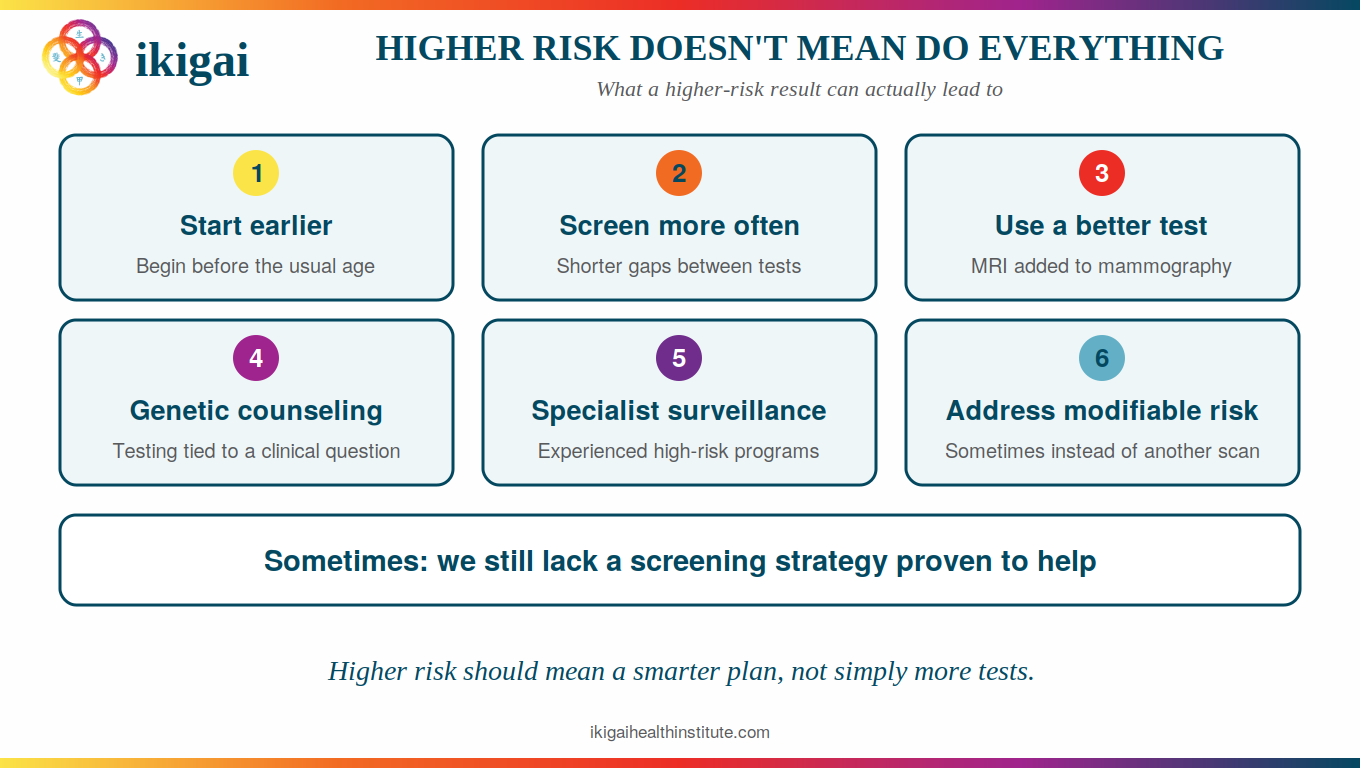
This is why "high risk" should not become shorthand for "do everything." It should mean that we have enough information to reconsider the benefit-to-harm equation thoughtfully. Sometimes the correct response to increased risk is earlier screening. Sometimes it is more frequent screening. Sometimes it is a better test. Sometimes it is genetic counseling. Sometimes it is referral to a specialized surveillance program. Sometimes it is aggressive attention to a modifiable risk factor rather than another scan. And sometimes, after considering the evidence, the right answer is that we still do not have a screening strategy proven to help. A truly personalized approach has to leave room for all of those answers.
The Risk Profile Should Not Sit Still
There is another reason we think about cancer screening as a longitudinal process rather than an annual checklist: your risk profile changes. You age. Your family ages. New cancers appear in relatives. Genetic testing becomes available. A colonoscopy finds a polyp. Breast density changes. A smoking history moves further into the past. New evidence changes screening recommendations. A test that was experimental five years ago may eventually become useful; another that once looked promising may fail to show that it improves outcomes. This means cancer risk assessment should not be a one-time event.
At Ikigai, we think the better model is to maintain a living cancer risk profile: which cancers concern us and why, which established screening recommendations apply, what makes this person different from average risk, and whether previous abnormalities are being followed appropriately. We revisit family history, consider when genetic counseling or testing might add useful information, and keep asking one particularly important question: Are we doing something because it is likely to help, or simply because we can? That question keeps personalization from turning into indiscriminate testing. The objective is not maximum screening. It is appropriate screening.
Personalized Does Not Mean Improvised
Cancer medicine is entering an era in which we can measure more than ever before. Genetic sequencing is increasingly accessible. Advanced imaging can see extraordinarily small abnormalities. Blood-based technologies are attempting to detect molecular signals of cancer before symptoms develop. Risk models are becoming more sophisticated, and artificial intelligence will almost certainly add another layer to how we estimate risk and interpret imaging. All of that creates opportunity. It also creates temptation.
The phrase "personalized cancer screening" can easily become a justification for assembling every available technology around a patient. That is not what we mean. The purpose of knowing more about risk is to make better decisions, not simply more decisions. The best cancer screening strategy begins with what has been proven to work. It then layers in what we know about the individual: family history, genetics, prior findings, exposures, age and other relevant risk factors. When those factors materially alter the probability of cancer—and when there is a screening strategy likely to provide meaningful benefit—the plan should change.
That is not a rejection of guidelines. It is how good guidelines are meant to be used. Population recommendations give us the map. Your risk tells us whether you are traveling the ordinary route. And sometimes, your risk changes the rules.
Take the Next Step
Wondering whether your family history, genetics, or past findings should change your own screening plan? That’s exactly the conversation we have with every patient.
Schedule a Consultation — Get a personalized read on whether your risk changes the rules—and what to do about it.
Join the Ikigai Newsletter — Follow this cancer series as we publish it.
Explore Our Programs — See how Ikigai builds a living cancer risk profile into ongoing care.
Recommended Reading
Cancer Risk Is Personal: Building Your Cancer Risk Profile — How the pieces of individual risk come together.
Cancer Screening: The Proven Playbook—and Where We Go Beyond It — The evidence-based foundation this post builds on.
Cancer Screening: Why Earlier Can Be Better—but More Is Not Always Better — Lead-time bias, overdiagnosis, and the harms of over-testing.
Breast Cancer: Why Early Detection Changes Everything — A closer look at breast screening and risk.
References
US Preventive Services Task Force. Screening for Lung Cancer: Recommendation Statement. JAMA, 2021.
The information in this post is for educational purposes only and is not intended as medical advice. Decisions about cancer screening should be made with a physician who knows your personal and family history.