

An abnormal scan, lump, or test result is a clue, not a diagnosis. Many findings turn out to be harmless, and many cancers found this way are highly treatable, so what happens next depends on what the finding looks like, your personal risk, and what further testing shows. Doctors may recommend more testing, careful surveillance, treatment, or in some cases nothing further. The key is that someone answers the question and carries the plan through, because research shows many recommended follow-up scans never happen.
What's in this post?
- When a scan finds something unexpected: What "incidental" findings are and why they matter.
- An abnormality is not a diagnosis: Kidney cysts, lung nodules, and rising PSA.
- How doctors decide whether a finding is concerning: Probability, personal risk, and timing.
- When an abnormal finding needs more testing: Choosing the next test and the right specialist.
- Watching carefully is not the same as doing nothing: What good surveillance looks like.
- Who owns the finding?: How findings fall through the cracks.
- The real value of looking earlier: What patients should ask.
A 58-year-old man arrives at the emergency department with abdominal pain. His physician orders a CT scan, looking for appendicitis, kidney stones, or another explanation for his discomfort. The scan identifies the problem, but the radiologist also notices something unexpected: a small mass in his left kidney. The patient has no urinary symptoms, no blood in his urine, and no reason to suspect anything is wrong with his kidneys. Yet an ordinary visit to the emergency department has suddenly raised the possibility of cancer. Even after his original problem is addressed, the unexpected finding may be the one that occupies his thoughts.
A woman discovers a lump in her breast while showering. Another man notices that one of his testicles feels different. A third receives a message that his prostate-specific antigen (PSA), a blood marker used in prostate cancer screening, has risen since his last examination. None knows whether they have cancer. Many of these findings will not turn out to be cancer, and many cancers discovered this way are highly treatable. But each deserves an answer to the same question: What should happen next?
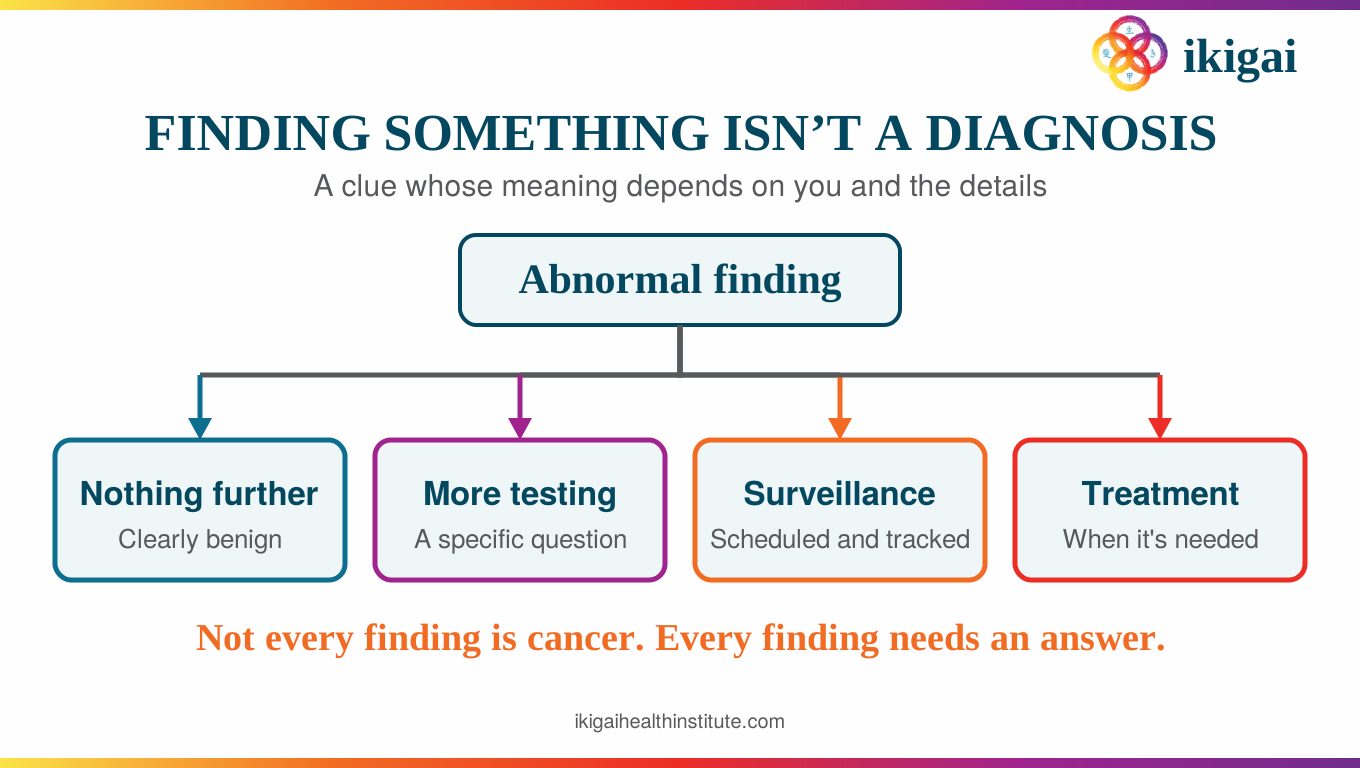
Finding an abnormality is not the same as diagnosing a disease. A lump, a shadow on a scan, or an unexpected laboratory result is a clue whose meaning depends on the person, their health history, and the circumstances. Sometimes it demands immediate attention. Sometimes it calls for additional testing or careful observation. And sometimes, after appropriate evaluation, the best medical decision is to do nothing further. The challenge is knowing the difference.
When a Scan Finds Something Unexpected
Physicians frequently encounter unexpected abnormalities while investigating unrelated medical problems. Radiologists call these discoveries incidental findings. A CT scan obtained after a car accident reveals a lung nodule. An ultrasound ordered for abdominal pain identifies a kidney lesion. An MRI performed for back pain uncovers an abnormality in a nearby organ. The finding may have nothing to do with the original complaint, but it may ultimately prove more consequential.
The word incidental can be misleading. It describes how something was discovered, not whether it matters. Many findings are harmless variations or benign abnormalities that will never affect a person's health. Others represent early disease, including cancers that have not yet produced symptoms. Some cancers are far more treatable when discovered before they have spread.
There is a larger reason these discoveries deserve attention. Roughly 70% of cancer deaths in the United States arise from cancer types for which we lack established, routinely recommended screening programs. We explored this gap in an earlier Ikigai Insights article, Cancer Screening Today: What We Find, What We Miss, and Why We Think We Can Do Better. For many cancers responsible for the greatest loss of life, we aren't routinely looking for them in people who feel healthy. It should hardly surprise us that a scan obtained for an unrelated reason occasionally reveals a cancer growing quietly. Such discoveries may create an opportunity to intervene earlier, although not every cancer found early benefits from earlier treatment.
At Ikigai, we approach this opportunity deliberately. Rather than waiting for symptoms, we use individualized risk assessment, appropriate screening, and, in selected circumstances, advanced imaging to look for consequential disease early enough to change its course. But the more carefully we look, the more likely we are to encounter findings whose significance is uncertain. A thoughtful screening program must be prepared to interpret those discoveries and determine what happens next.
An Abnormality Is Not a Diagnosis
Consider two patients whose CT scans reveal abnormalities in their kidneys. One has a simple fluid-filled cyst with imaging characteristics that reliably identify it as benign. The other has a solid mass with features that raise concern for kidney cancer. Both have an abnormal imaging report, yet their clinical paths may be entirely different.
The first patient may need nothing further. Simple kidney cysts are common, particularly with advancing age, and a cyst that imaging clearly shows is harmless generally requires neither treatment nor surveillance. The second patient may need dedicated imaging and evaluation by a urologist, who can help determine whether surveillance, biopsy, or treatment is appropriate. The abnormality's appearance, location, and other characteristics provide clues about what it represents.
A lung nodule offers another example. Small pulmonary nodules are common on chest CT scans, and most are not cancer. Some are scars from previous infections or areas of inflammation. But their significance changes with size, shape, growth over time, and personal risk factors. A tiny, stable nodule in someone who has never smoked may require a very different approach from a growing, irregular nodule in someone with a substantial smoking history.
The same reasoning applies beyond imaging. A rising PSA does not establish a diagnosis of prostate cancer. PSA can fluctuate or increase because of benign prostate enlargement, inflammation, and other factors. Repeating an unexpectedly elevated result is often the first step. If the elevation persists, age, previous results, prostate size, family history, and other risk factors help determine whether prostate MRI or evaluation by a urologist is appropriate.
The goal is not to react to every abnormal result. It is to understand what the result means and respond accordingly.
How Doctors Decide Whether a Finding Is Concerning
Medicine rarely offers absolute certainty when an abnormality is discovered. Physicians work with probabilities, using available evidence to estimate how likely a finding is to represent significant disease and how much investigation is justified.
Individual risk can substantially change that calculation. A pulmonary nodule in a lifelong nonsmoker may carry a different probability of cancer than a similar nodule in someone with decades of tobacco exposure. A breast abnormality in a woman with a strong family history or an inherited genetic change that increases cancer risk may warrant greater concern than the same finding in someone at average risk. A pancreatic lesion discovered in someone with a significant family history of pancreatic cancer also deserves careful consideration of that background.
This is why understanding individual cancer risk matters before screening begins and whenever something unexpected is discovered. Age, family history, inherited risk, environmental exposures, and prior findings help physicians interpret new information, and as we explored in When Your Risk Changes the Rules, a higher-risk profile can change what we recommend. But probability is only part of the decision. We must also consider what could happen if a finding is not investigated, how quickly serious disease might progress, and whether additional testing would change the next step.
Many lumps in the scrotum turn out to be harmless, including cysts and fluid collections. A firm lump within the testicle itself is different and deserves prompt evaluation, typically including ultrasound and consultation with a urologist. Likewise, a new breast mass deserves assessment even after a normal screening mammogram. A reassuring previous test does not automatically explain a new physical finding.
Other abnormalities allow more time for deliberation. Immediate invasive testing may offer little advantage over additional imaging or planned surveillance. Clinical guidelines provide an essential foundation, but they don't eliminate uncertainty. Different experts may reasonably recommend different approaches when evidence is incomplete. Good medicine requires understanding the science, recognizing its limitations, and applying it to the individual.
Delaying evaluation of a suspicious finding can allow consequential disease to progress. Pursuing every minor abnormality with invasive testing can expose patients to complications, anxiety, and unnecessary treatment, a tension we described in Why Earlier Can Be Better—but More Is Not Always Better. Neither automatically dismissing a finding nor rushing into intervention is a substitute for thoughtful medicine.
When an Abnormal Finding Needs More Testing
When an abnormality warrants investigation, the next test should answer a specific clinical question. A kidney lesion that cannot be characterized on an initial scan might benefit from dedicated CT or MRI. A suspicious breast finding may require diagnostic mammography, targeted ultrasound, or biopsy. A concerning pulmonary nodule might warrant comparison with prior imaging, interval CT surveillance, PET imaging, or tissue sampling, depending on its characteristics and the patient's risk.
These decisions often involve specialists. A urologist may evaluate a kidney mass or concerning prostate finding. A gastroenterologist with pancreatic expertise may assess certain pancreatic abnormalities. A pulmonologist or thoracic surgeon may help manage a suspicious lung lesion. An oncologist becomes particularly important when cancer is diagnosed or the circumstances warrant oncology expertise. The objective is to involve the right expertise at the right time while maintaining a clear understanding of the patient's overall health.
Patients sometimes assume that a suspicious finding should immediately lead to a biopsy. But obtaining tissue isn't always the best first step. Additional imaging may provide sufficient information, or specialist evaluation may help determine whether biopsy is appropriate. Sometimes its risks outweigh the information it would provide. The question isn't simply whether we can obtain tissue, but whether doing so will help determine the best course of action.
Watching Carefully Is Not the Same as Doing Nothing
One of the more difficult conversations in medicine occurs when a physician recommends surveillance rather than immediate intervention. Imagine learning that a scan identified an abnormality that could represent early cancer, only to hear that the plan is another scan in six months. Waiting may seem counterintuitive. Why wouldn't we want to find out immediately?
Some abnormalities are best understood by observing their behavior over time. Certain small pulmonary nodules, pancreatic cysts, and selected kidney masses can be managed with established surveillance strategies. Stability or growth provides useful information, and immediate invasive testing does not always improve outcomes. Some small kidney cancers grow slowly enough that carefully selected patients may benefit more from surveillance than immediate treatment. Finding cancer early does not automatically mean treating it immediately will improve health.
Surveillance must be an active medical decision, not a vague suggestion to check again someday. A thoughtful plan specifies what is being monitored, when reassessment should occur, what changes would prompt investigation, and who is responsible for reviewing results. Surveillance is not appropriate for every finding; highly suspicious abnormalities may require prompt evaluation.
Recommending another scan is only the beginning. Someone must ensure it is scheduled, completed, interpreted, and compared with prior examinations. If the finding changes, the plan must change with it. Without that follow-through, surveillance is not a strategy. It is an unfinished task.
Who Owns the Finding?
Consider an unexpected pulmonary nodule discovered during an emergency department visit. The radiologist recommends a follow-up CT scan. The emergency physician discusses it with the patient and includes the recommendation in the discharge instructions. The patient returns home, feeling better from the original problem that brought them to the hospital.
Six months later, who is making sure the scan happens?
The radiologist may never see the patient again. The emergency physician was focused on the acute visit. The patient's primary care clinician may not have received the report. And the patient, dealing with pain, medications, and other concerns during the original encounter, may not remember the recommendation. No single person necessarily made an unreasonable decision, yet an important finding can disappear between different parts of the healthcare system.
Research suggests that incidental findings are remarkably common. A large analysis identified them in nearly one-third of emergency department CT encounters. Yet discovery doesn't guarantee follow-up. In one study at an academic medical center, fewer than four in ten recommendations for additional imaging were completed. These weren't necessarily missed cancers, but they were unfinished evaluations, each representing a clinical question that remained unanswered.
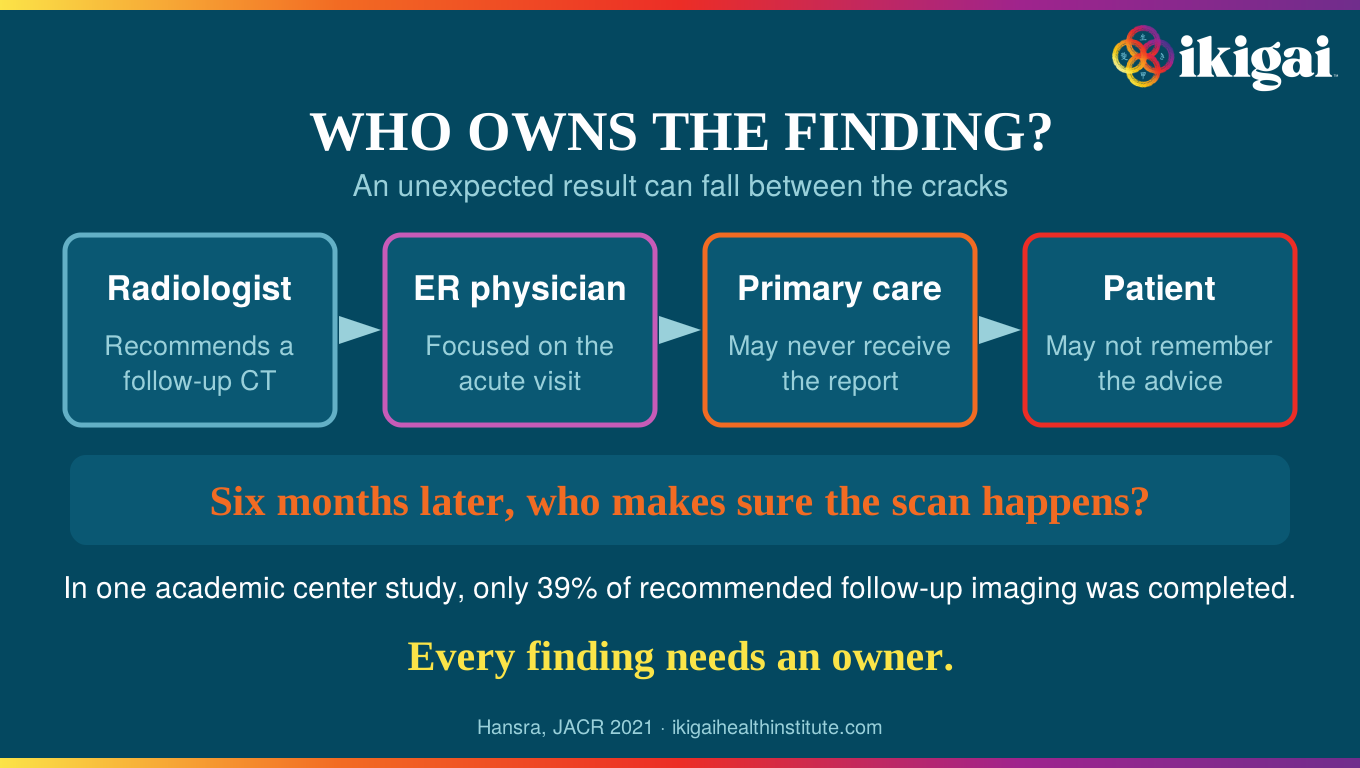
This is a vulnerability of fragmented medical care. Identifying an abnormality, recommending follow-up, and completing that follow-up are separate events. A successful early-detection strategy requires all three.
At Ikigai, we view cancer screening as an ongoing process that doesn't end when test results arrive. We assess risk, select screening strategies, interpret findings, coordinate further evaluation, and track unresolved abnormalities. When specialists are needed, we help patients navigate that process and incorporate recommendations into their care plans.
Not every abnormality requires endless monitoring. A finding clearly established as benign may be closed out with confidence. But when further evaluation or surveillance is necessary, the plan should remain visible until the appropriate next step is completed. A potentially important finding should never depend solely on a patient's memory or the hope that someone else will follow up.
The Real Value of Looking Earlier
Remember the man whose emergency department CT revealed an unexpected kidney mass? His next step isn't determined simply by the word mass in the radiology report. It depends on the imaging characteristics, whether additional studies are needed, and what a urologist recommends. The finding may require treatment or surveillance, or further evaluation may establish that no intervention is necessary. What matters is that the question is answered and the plan carried through.
The promise of early cancer detection isn't simply that technology allows us to see more. In selected circumstances, finding consequential disease before symptoms develop creates treatment opportunities that might otherwise be lost. A small kidney cancer may be treatable while confined to the kidney. A suspicious breast lump evaluated promptly may lead to diagnosis at a more treatable stage. Not every early finding represents a dangerous cancer, and earlier treatment doesn't always improve outcomes. But these opportunities make thoughtful early detection worth pursuing.
Realizing them requires more than sophisticated equipment or an extensive menu of screening tests. It requires physicians who interpret findings in context, recognize uncertainty, distinguish meaningful risk from harmless variation, involve appropriate specialists, and remain responsible for what happens next.
For patients, there is a practical lesson. If you discover a lump, receive an abnormal test result, or learn that imaging identified something unexpected, don't assume the worst. But don't assume that the absence of symptoms means it can be ignored. Understand what was found, whether further evaluation is needed, when it should happen, and who will review the results. For Ikigai patients, your care team helps coordinate and track these decisions so you're not navigating the process alone. Finding something is the beginning of a clinical decision, not the end. What matters is whether we understand what we found—and have a thoughtful plan for what to do about it.
Take the Next Step
Received an abnormal result, or not sure whether a past finding was ever followed up? That's exactly the kind of question we help patients work through.
Schedule a Consultation — Get a clear, personalized plan for what your result means and what comes next.
Join the Ikigai Newsletter — Get our Insights series delivered to your inbox.
Explore Our Programs — See how Ikigai tracks findings and follow-up as part of a complete longevity strategy.
Recommended Reading
- Cancer Screening Today: What We Find, What We Miss, and Why We Think We Can Do Better — The screening gap that makes unexpected findings so important.
- Cancer Risk Is Personal: Building Your Cancer Risk Profile — Why your own risk changes how a finding is interpreted.
- When Your Risk Changes the Rules — How family history, genetics, and prior findings change the plan.
- Cancer Screening: Why Earlier Can Be Better—but More Is Not Always Better — False positives, overdiagnosis, and why more looking isn't always better.
- Whole-Body MRI and Advanced Imaging: How Much Should We Look? — What advanced imaging can find, and the incidental findings that can follow.
References
- NORC at the University of Chicago. New research highlights just one in seven diagnosed cancers found by a recommended screening test. Press release, December 14, 2022.
- Evans CS, et al. Incidental radiology findings on computed tomography studies in emergency department patients: a systematic review and meta-analysis. Annals of Emergency Medicine, 2022.
- Hansra SS, et al. Factors affecting adherence to recommendations for additional imaging of incidental findings in radiology reports. Journal of the American College of Radiology, 2021;18(2):233-239.
The information in this post is for educational purposes only and is not intended as medical advice. If you have found a lump, received an abnormal test result, or been told that imaging showed something unexpected, contact your physician promptly to discuss next steps.