

Overview
Strength training may help protect women's brains as they age, though it hasn't been proven to prevent dementia. In a ten-year study of female twins, women with greater leg power experienced less cognitive decline, and several randomized trials show that progressive resistance training can modestly improve executive function and attention in older women. The benefit appears to depend on actually getting stronger, not just showing up at the gym: at least twice weekly, with weights heavy enough to be challenging and increased over time.
What's in this post?
- What strong legs revealed about cognitive aging: A ten-year twin study and why leg power stood out.
- What happens when women actually start lifting weights: What randomized trials show for executive function, attention, and memory.
- Your muscles may be doing more than moving your body: Glucose, blood pressure, inflammation, and BDNF.
- Why midlife may be an important opportunity: Menopause, muscle, and building strength early.
- The goal is to become stronger: Why progressive effort matters.
- What effective strength training looks like: Frequency, exercises, osteoporosis, and consistency.
- Can stronger muscles prevent dementia?: What has, and hasn't, been shown.
- An investment in the brain you want decades from now: How strength fits a long-term brain health strategy.
Imagine two women in their mid-50s. They're twins, with similar genetic backgrounds and many shared experiences. But one has substantially more powerful legs than the other. Ten years later, researchers assess how their brains have aged. Could something as seemingly unrelated as leg power help predict which woman has maintained more of her memory and thinking abilities?
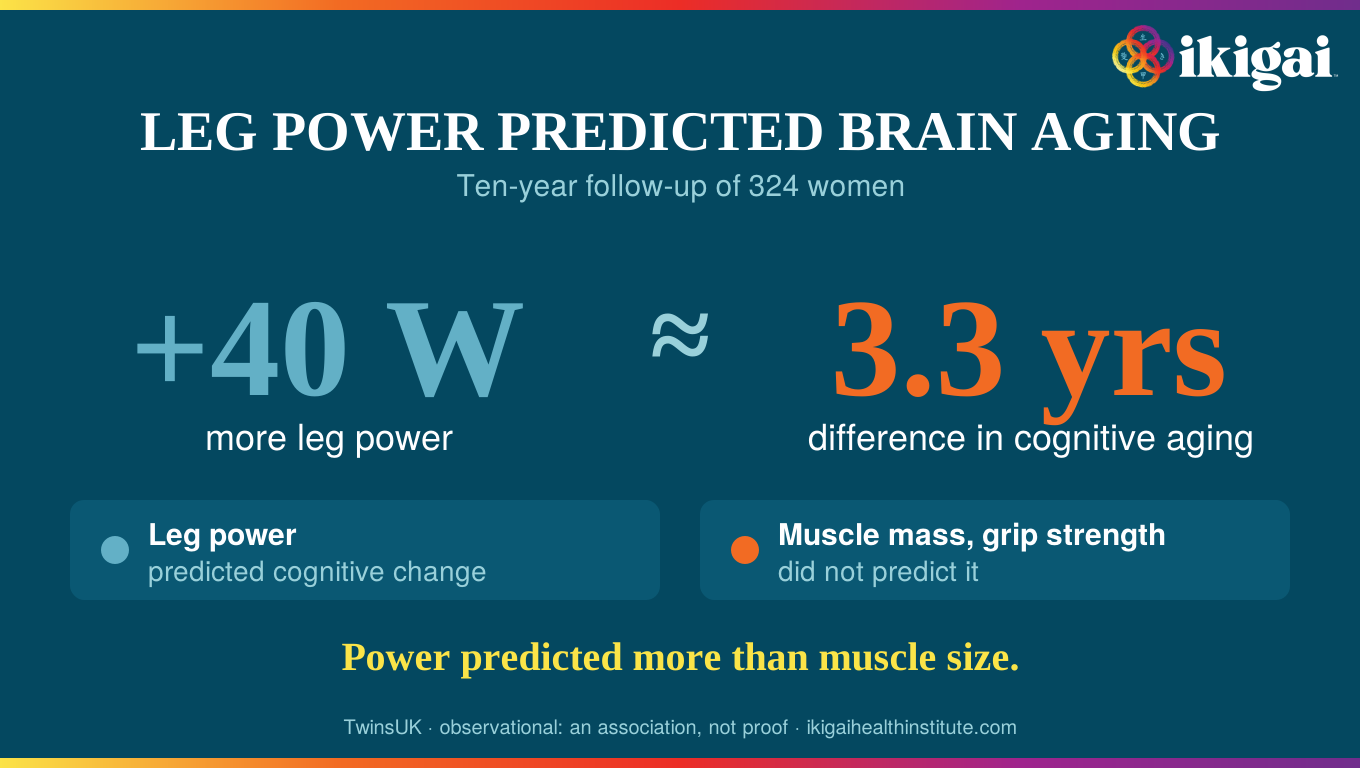
That question was explored in a study involving 324 women in the United Kingdom. Researchers measured their physical abilities, including how much power their legs could generate, and followed their cognitive performance over approximately a decade. What they discovered added an unexpected dimension to the conversation about strength training and women's brain health. For decades, women have been encouraged to lift weights to protect their bones, preserve muscle, and maintain independence. Those benefits are well established. But scientists are investigating another possibility: the strength women develop and maintain may also influence how well their brains function years later.
What Strong Legs Revealed About Cognitive Aging
The women participating in the TwinsUK study were about 55 years old on average, ranging from their early 40s to their early 70s. Investigators measured several aspects of physical performance, including leg power, which describes how quickly muscles can generate force. It's an ability we rely on when climbing stairs, rising from a chair, or recovering our balance after a stumble.
A decade later, women who had demonstrated greater leg power generally experienced less decline in cognitive performance. The relationship persisted after researchers accounted for several factors that might influence brain health. The difference was modest but meaningful. Approximately 40 additional watts of leg power were associated with a difference in cognitive aging comparable to roughly 3.3 years. That's a statistical comparison, not evidence that stronger legs literally make a woman's brain three years younger, but it helps put the finding into perspective.
The twin design added another dimension. Because twins share aspects of their genetic background and early environment, researchers could examine whether differences in physical performance were associated with differences in cognitive aging. Some comparisons supported the relationship, although the findings were less convincing among identical twins, where the sample was particularly small.
Researchers also measured the amount of muscle in the women's legs, along with grip strength. Neither predicted cognitive change in the same way that leg power did. In this study, what the muscles could do appeared more informative than how much muscle the women had. That doesn't diminish the importance of muscle mass. Muscle is one of the body's largest destinations for circulating glucose, and preserving it supports glucose regulation and metabolic health. We want women to maintain healthy muscle mass and develop the strength to use it effectively. These are complementary goals, not competing ones.
The study was observational, so it couldn't establish that stronger legs caused better cognitive outcomes. Women with greater leg power may have differed in other important ways, including lifelong activity patterns or underlying health. Nevertheless, the findings raised a provocative question: if muscular performance predicts cognitive aging, could deliberately improving strength help preserve cognitive function?
What Happens When Women Actually Start Lifting Weights
Researchers have explored that question through clinical trials in which participants complete structured resistance-training programs. In one trial involving 155 women between the ages of 65 and 75, participants completed a year of resistance training or a comparison program emphasizing balance and muscle tone. Some women lifted weights once weekly, others twice weekly. Researchers wanted to know whether strength training could change how their brains worked.
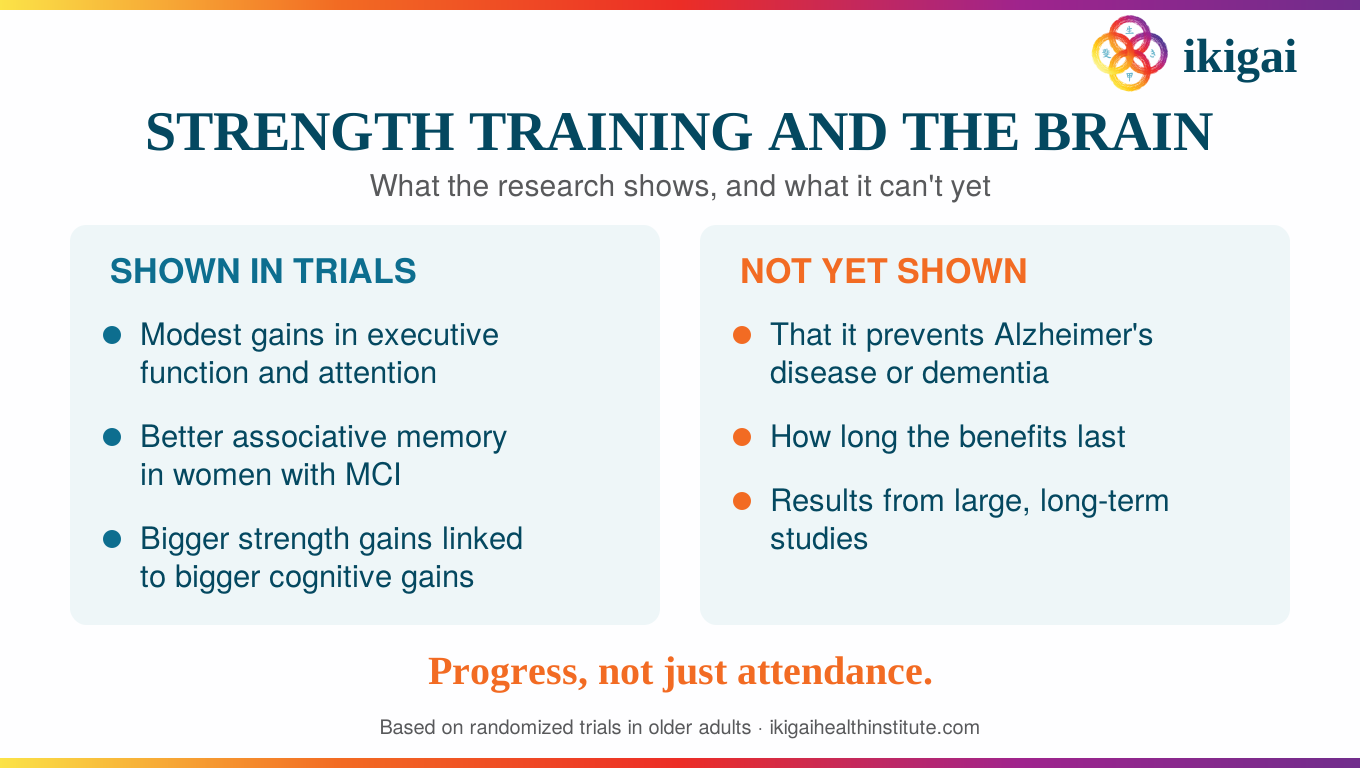
Women participating in resistance training improved on certain measures of executive function, the mental abilities that help us organize information, make decisions, manage distractions, and control our responses. These are skills we use constantly, whether following a complicated conversation or juggling competing responsibilities. Other trials have reported improvements in selected cognitive abilities, including attention and associative memory, which helps us connect information, such as remembering someone's name after an introduction. The findings haven't been uniform across studies, and improvements have generally been modest. Still, several randomized trials have demonstrated that resistance training can influence aspects of cognitive performance.
Follow-up testing after the trial involving 155 women revealed that certain improvements in attention remained detectable a year after the formal training program ended, specifically among the women who had trained once weekly. We don't know how long such benefits persist, but the finding suggests that some cognitive changes associated with resistance training may outlast the intervention itself.
Another clue came from the SMART trial involving 100 older adults with mild cognitive impairment. Participants completed six months of progressive resistance training, and researchers examined how changes in strength related to changes in cognition. Those who gained more strength generally experienced greater cognitive improvements. Further analysis suggested that strength gains statistically explained part of the benefit. This doesn't prove that stronger muscles directly caused better brain function, but it raises an important possibility: the degree to which someone actually becomes stronger may matter. There's a difference between lifting weights and becoming stronger.
Your Muscles May Be Doing More Than Moving Your Body
Most of us think about muscles in mechanical terms. They allow us to walk, climb stairs, carry groceries, and get out of a chair. But muscle is also metabolically active tissue that influences processes throughout the body. It helps regulate blood glucose, participates in inflammatory signaling, and contributes to cardiovascular health. Researchers are investigating whether these functions help explain the relationship between muscular strength and cognitive aging.
Muscle is one of the body's largest consumers of glucose, and resistance training can improve how effectively muscle cells respond to insulin. That's important because insulin resistance and poor metabolic health are associated with increased cognitive risk. Blood pressure offers another connection. Persistently elevated blood pressure can damage small blood vessels in the brain, affecting the networks that allow different regions to communicate. Resistance training can help lower blood pressure and may reduce certain markers of chronic inflammation, another process implicated in diseases of aging.
Scientists are also investigating whether exercising muscles influence the brain through chemical signals. One possibility involves brain-derived neurotrophic factor, or BDNF, a protein that helps brain cells survive, communicate, and form new connections. Researchers are studying whether strength training influences this process, although human studies have produced mixed results and haven't established BDNF as the explanation for cognitive benefits.
Brain imaging offers additional clues. In a subgroup of women from the yearlong resistance-training trial who already had changes in the brain's white matter, twice-weekly training slowed the progression of certain abnormalities. White matter contains the connections that allow different brain regions to exchange information. Although imaging results haven't been consistent across studies, these findings suggest that muscular strength and cognitive health may be connected through several biological pathways.
Why Midlife May Be an Important Opportunity
For many women, strength becomes more relevant during the years surrounding menopause. Changes in estrogen levels, combined with aging, can contribute to shifts in body composition, declining strength, and greater difficulty maintaining muscle mass. At the same time, some women notice changes in concentration, word retrieval, or memory. Sleep disruption, hot flashes, and other features of menopause can contribute to these experiences, which shouldn't automatically be interpreted as evidence of progressive cognitive decline. We explore this in more depth in Menopause and the Aging Brain.
The relationship between menopause and cognition is complex, and research hasn't established that strength training specifically reverses menopause-related cognitive changes. Nevertheless, midlife offers an opportunity to influence the trajectory of muscular strength before substantial losses occur. The physical abilities that support independence in our 70s and 80s are influenced by the habits and capacities we develop decades earlier. Strength isn't something we suddenly need when we become older. It's something worth building and maintaining throughout adulthood.
The Goal Isn't Just to Lift Weights. It's to Become Stronger
Meaningful strength training requires more than showing up at the gym. The women in trials demonstrating cognitive benefits weren't casually moving light dumbbells through a comfortable routine. They performed resistance exercises with weights heavy enough that the final repetitions were genuinely challenging. As they became stronger, the resistance increased.
Many people underestimate how hard they need to work to develop strength. A familiar exercise performed with the same comfortable weight month after month may no longer provide enough challenge to produce improvement. Muscles adapt when they're given a reason to do so. Progressive resistance training means gradually increasing the demands placed on the body, whether by lifting heavier weights, performing additional repetitions, or progressing to more challenging exercises.
The goal isn't to lift the heaviest weight possible or leave every workout exhausted. It's to work hard enough to stimulate adaptation while maintaining good technique and allowing adequate recovery. There's a difference between productive effort and unnecessary risk. Professional guidance can make an enormous difference, particularly for women who have never been taught how to select appropriate weights or progress safely. A qualified strength coach or physical therapist can help establish a program that produces real results rather than simply filling time in the gym. Hiring a professional is an investment in learning how to train effectively.
What Does Effective Strength Training Look Like?
A reasonable minimum is resistance training twice weekly, with sessions that challenge the major muscle groups. Women with more experience may benefit from three sessions per week, depending on their goals and recovery. A well-designed program should challenge the legs and hips, upper body, and muscles supporting the trunk. Squats, step-ups, hip hinges, pushing and pulling movements, and loaded carries can all have a place, although exercises should reflect individual abilities and circumstances.
Progress should be measurable. Tracking resistance, repetitions, and improvements in specific movements helps determine whether a program is developing strength. The objective isn't a particular appearance or number on a scale. It's to build physical capacity that supports the activities you want to pursue throughout life.
Women with osteoporosis sometimes avoid lifting weights because they're concerned about fractures. Yet research involving postmenopausal women with low bone density has demonstrated that appropriately supervised, high-intensity resistance training can improve bone density without causing vertebral fractures in the studied group. That doesn't mean every exercise or level of loading is appropriate for every woman. It means low bone density shouldn't automatically end the conversation about strength training. Discussing the evidence and an individualized approach with your healthcare provider is a reasonable place to begin.
Consistency matters enormously. An ambitious routine that lasts three weeks is unlikely to accomplish much. A thoughtful program performed regularly over years can help preserve and develop strength through multiple decades. A woman beginning at 50 may focus on learning proper technique, while at 60 she may be challenging herself with greater resistance. At 75, maintaining strength may help her continue traveling, hiking, carrying grandchildren, or pursuing activities that make life meaningful. The objective isn't simply to exercise. It's to develop the strength to keep doing the things you love.
Can Stronger Muscles Prevent Dementia?
It's a question many women will understandably ask, particularly those who have watched a family member struggle with Alzheimer's disease. The answer requires distinguishing between improving cognitive performance and preventing dementia. (For more on why women face a higher burden, see Why Alzheimer's Disease Disproportionately Affects Women.)
Several smaller randomized trials have shown that resistance training can improve certain cognitive abilities, particularly aspects of executive function. Observational studies also suggest that women with greater muscular strength or better physical function may experience more favorable cognitive aging. What researchers haven't demonstrated is that strength training reduces the number of women who ultimately develop Alzheimer's disease or another form of dementia. Establishing that outcome would require large studies following participants for many years.
The relationship between physical strength and cognitive health may also work in both directions. Early brain changes could contribute to declining physical performance, meaning weakness may sometimes be an early sign of cognitive changes rather than simply a contributor to them. We looked at one version of this question in Stroke, Strength, and the Surprising Link to Alzheimer's. These uncertainties remind us that promising research shouldn't be turned into guarantees.
Fortunately, the case for strength training doesn't depend on proving that it prevents dementia. Preserving strength helps maintain mobility, metabolic health, bone health, and physical independence. The possibility of supporting cognitive function adds another reason to make it a priority.
An Investment in the Brain You Want Decades From Now
We tend to separate physical health from brain health, as though the muscles that move our bodies and the brain that directs them belong to entirely different systems. The emerging research suggests that distinction may be too simple. Muscular strength is connected to metabolic health, vascular function, physical resilience, and potentially the biological processes that support cognitive aging.
At Ikigai, we view muscular strength as a capacity worth developing, measuring, and following over time. We want women to maintain healthy muscle mass, become stronger, move confidently, and preserve the ability to pursue meaningful activities throughout their lives. Strength training complements the cardiovascular fitness, metabolic health, sleep, and other factors we've explored in previous Insights, and it's one piece of the Ikigai Brain Health Plan. It's another important investment in long-term cognitive health, not a replacement for those other priorities.
For women who already lift weights, the research offers another reason to remain consistent and continue progressing. For those who haven't made strength training a priority, it offers a reason to begin. Stronger bones, healthier muscles, and greater independence are reason enough to invest in strength training. The possibility that the same investment may help preserve how well we think, remember, and navigate the world makes it even more worthwhile.
Build strength for your future.
Get a personalized, evidence-based plan for building strength and supporting your long-term brain health.
Take the Next Step
Wondering how strong you are today, and what a smart strength plan looks like for your age, health, and goals? That's exactly the kind of question we help patients work through.
Schedule a Consultation — Get a personalized, evidence-based plan for building strength and protecting your brain.
Join the Ikigai Newsletter — Get our Insights series delivered to your inbox.
Explore Our Programs — See how Ikigai integrates strength, metabolic health, and brain health into one longevity strategy.
Recommended Reading
- Exercise and Brain Health: How Movement Protects Cognitive Function — The broader evidence for exercise and the brain, beyond strength training.
- Menopause and the Aging Brain — What the science says about hormones, memory, and thinking in midlife.
- Insulin Resistance and Brain Aging — The metabolic link that muscle helps regulate.
- Why Alzheimer's Disease Disproportionately Affects Women — Why this conversation matters especially for women.
- How to Build a Brain Health Plan: The Ikigai Playbook — How strength fits into a complete, personalized plan.
References
- Steves CJ, Mehta MM, Jackson SHD, Spector TD. Kicking back cognitive ageing: leg power predicts cognitive ageing after ten years in older female twins. Gerontology, 2016;62(2):138-149.
- Liu-Ambrose T, Nagamatsu LS, Graf P, Beattie BL, Ashe MC, Handy TC. Resistance training and executive functions: a 12-month randomized controlled trial. Archives of Internal Medicine, 2010;170(2):170-178.
- Davis JC, Marra CA, Beattie BL, et al. Sustained cognitive and economic benefits of resistance training among community-dwelling senior women: a 1-year follow-up study of the Brain Power Study. Archives of Internal Medicine, 2010;170(22):2036-2038.
- Nagamatsu LS, Handy TC, Hsu CL, Voss M, Liu-Ambrose T. Resistance training promotes cognitive and functional brain plasticity in seniors with probable mild cognitive impairment. Archives of Internal Medicine, 2012;172(8):666-668.
- Mavros Y, Gates N, Wilson GC, et al. Mediation of cognitive function improvements by strength gains after resistance training in older adults with mild cognitive impairment: outcomes of the Study of Mental and Resistance Training. Journal of the American Geriatrics Society, 2017;65(3):550-559.
- Bolandzadeh N, Tam R, Handy TC, et al. Resistance training and white matter lesion progression in older women: exploratory analysis of a 12-month randomized controlled trial. Journal of the American Geriatrics Society, 2015;63(10):2052-2060.
- Watson SL, Weeks BK, Weis LJ, Harding AT, Horan SA, Beck BR. High-intensity resistance and impact training improves bone mineral density and physical function in postmenopausal women with osteopenia and osteoporosis: the LIFTMOR randomized controlled trial. Journal of Bone and Mineral Research, 2018;33(2):211-220.
- Watson SL, Weeks BK, Weis LJ, Harding AT, Horan SA, Beck BR. High-intensity exercise did not cause vertebral fractures and improves thoracic kyphosis in postmenopausal women with low to very low bone mass: the LIFTMOR trial. Osteoporosis International, 2019;30(5):957-964.
The information in this post is for educational purposes only and is not intended as medical advice. Talk with your physician before starting a new strength-training program, especially if you have osteoporosis, a cardiovascular condition, joint problems, or other health concerns.